Haikei in Nankan Town, Kumamoto: Tour the Yamachiku Bamboo Chopstick Factory, Then Enjoy a Lunch Eaten Entirely with Chopsticks!
2026.08.21
About Haikei
Hello! I’m Aikero, a writer for Sarukuma. First my air conditioner broke, and now my fridge has given up too, so I’m in a state of mild despair!
Today I’m introducing a spot in Nankan Town, Tamana District, Kumamoto:
Haikei.
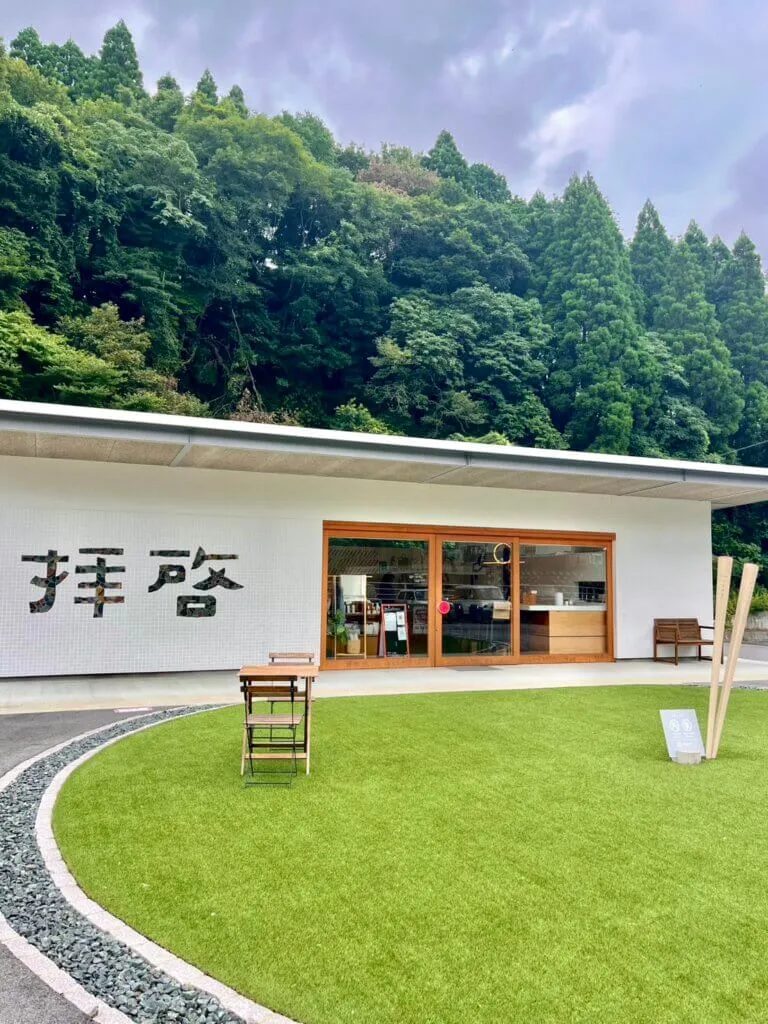 Haikei is the factory shop of Yamachiku, a bamboo chopstick maker that fellow Sarukuma writer Gachako covered in an earlier article.
It’s a surprisingly lively place: Yamachiku’s own events have drawn more visitors than the entire population of the town!
I went to one of their events a few years ago, and even though it was raining, the place was packed (^^)/
That’s where I first used their chopsticks at one of the food stalls, and I completely fell in love with how comfortable they felt ♡
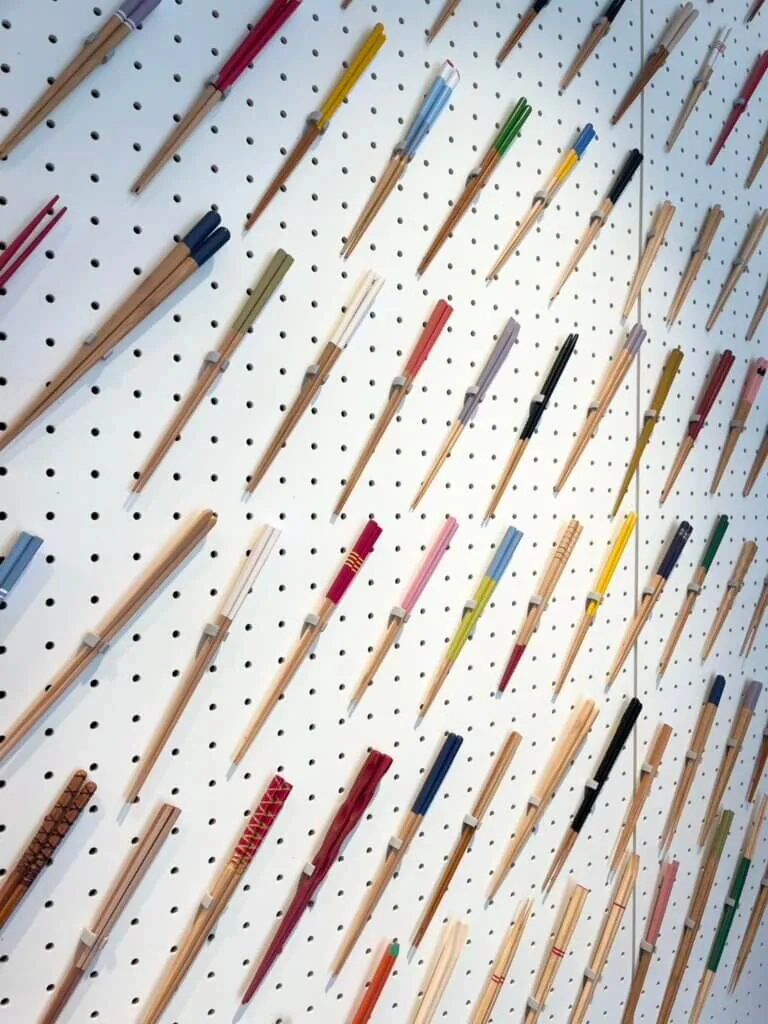 Every single pair of chopsticks Yamachiku makes is bamboo, and only bamboo.
I had never paid any attention to what my chopsticks were made of, but the first time I used Yamachiku’s at their event, I was amazed at how different they felt from my everyday pair!
Still, I never quite understood why bamboo chopsticks are so good.
So I decided to go and find out for myself on a factory tour!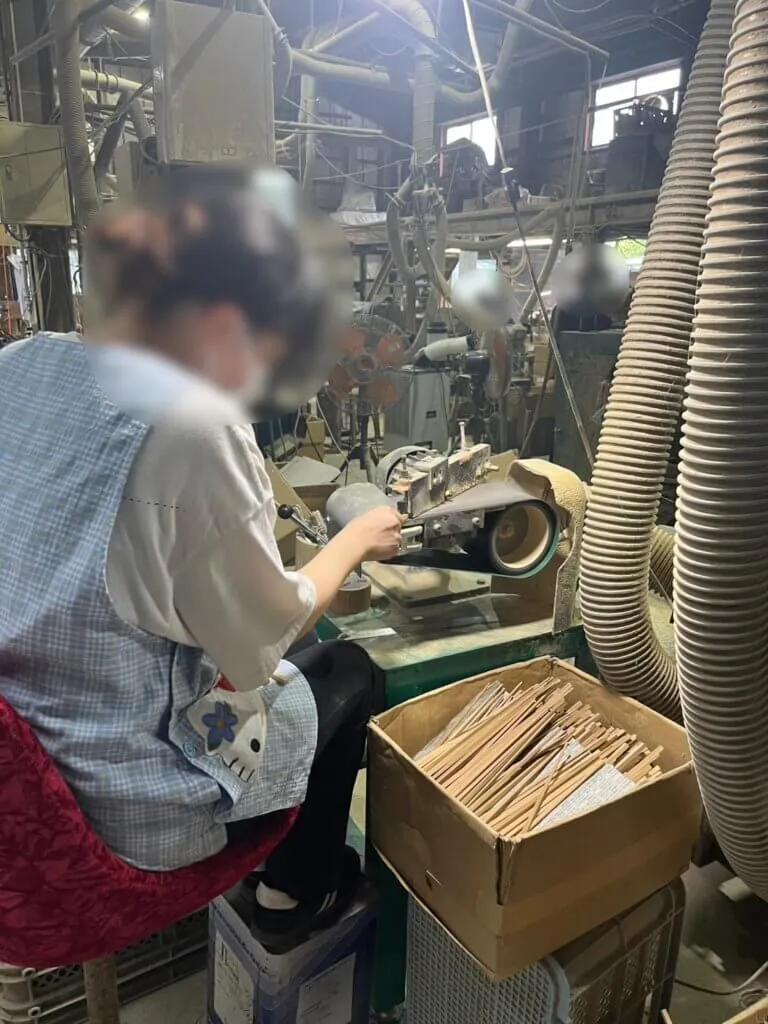 〈Yamachiku Factory Tour Information〉
Days: Monday, Tuesday, Friday, Saturday (only on days the factory is operating)
Time: 10:30 to 11:30 (60 minutes)
Capacity: Up to 10 people per tour
Price: ¥1,000 per adult, ¥500 for elementary school children, free for preschoolers
★ Includes a pair of chopsticks as a souvenir (repeat visitors receive a drink ticket instead)
Booking: Advance reservations through the official website are given priority. If spots are still available on the day, you can also sign up at the Haikei register. Please ask the staff for details.
*The mini chopstick-making experience varies depending on what’s being produced that day, such as shaving or painting chopsticks.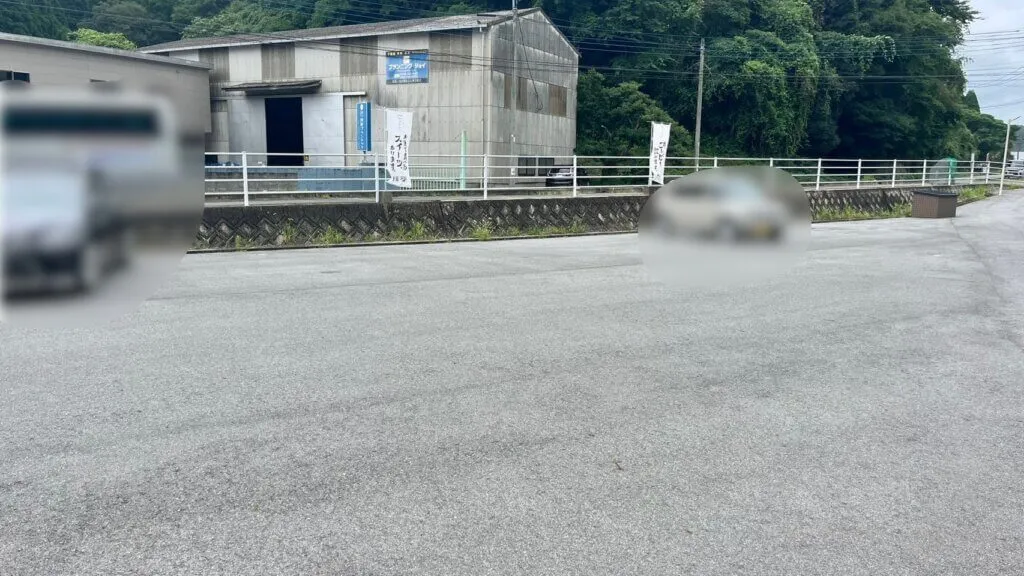 It’s just a 5-minute drive from Nankan IC.
There’s a spacious parking lot right on site.
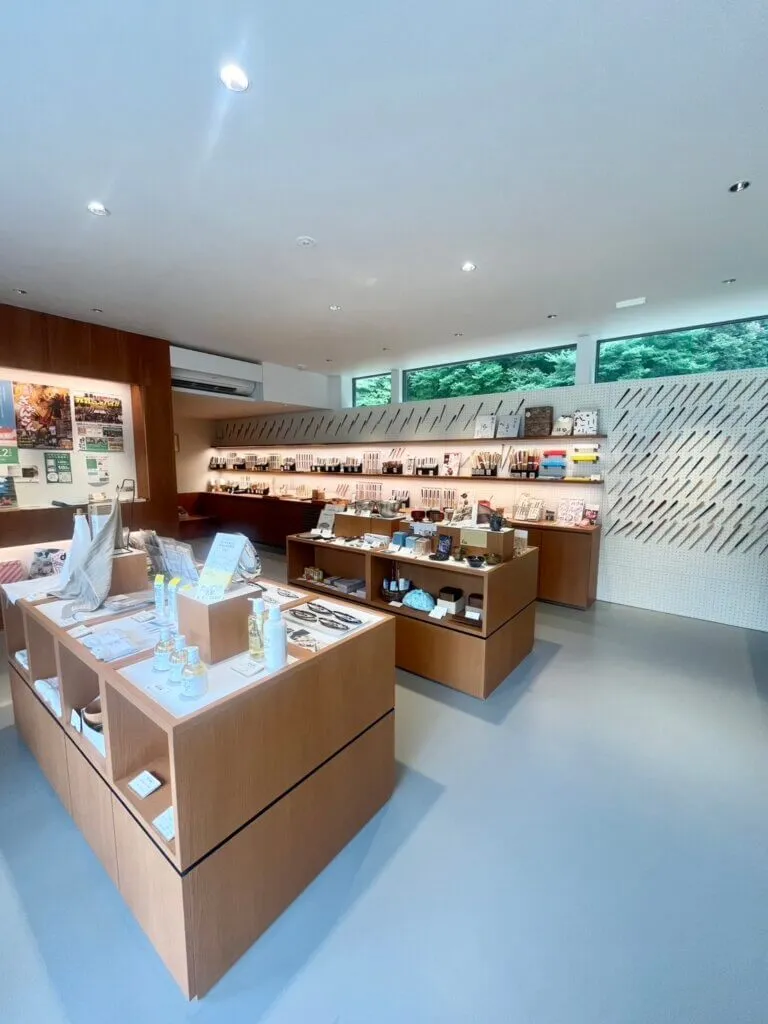 Inside the shop you’ll find chopsticks plus a curated selection of goods from factory brands all over Japan.
If you’re stuck on what to buy as a gift or souvenir, this is the place to come.
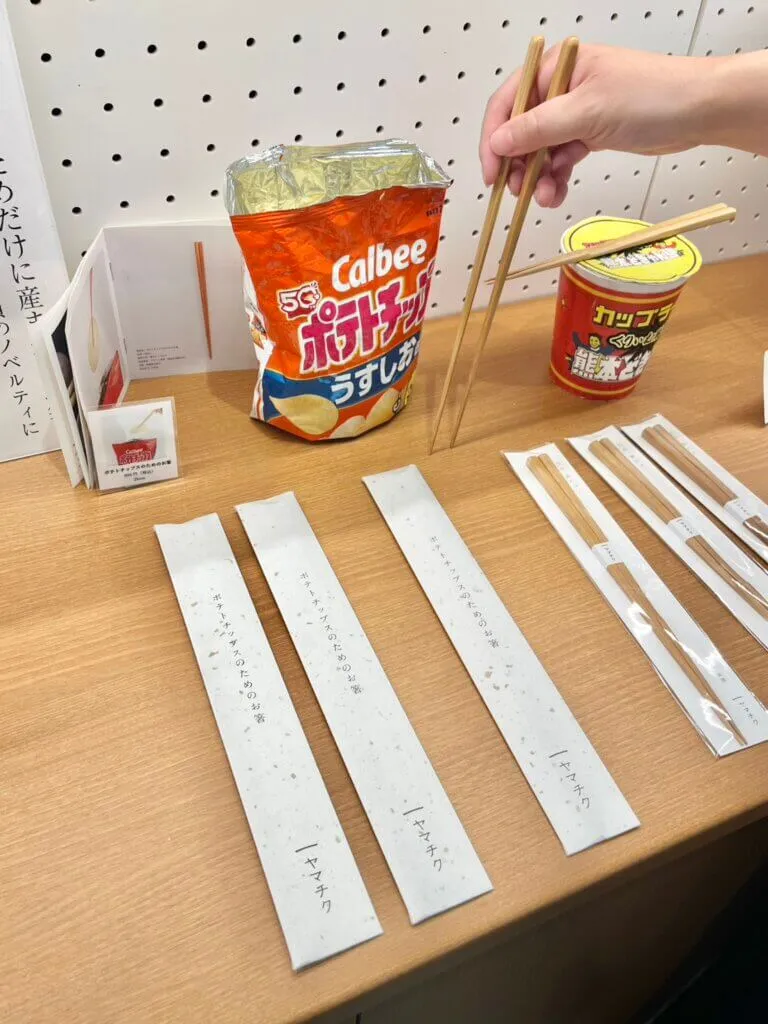 We now live in an age where even potato chips are eaten with chopsticks!
The handles are designed to stick out of the bag, so you can snack with chopsticks and never get greasy fingers.
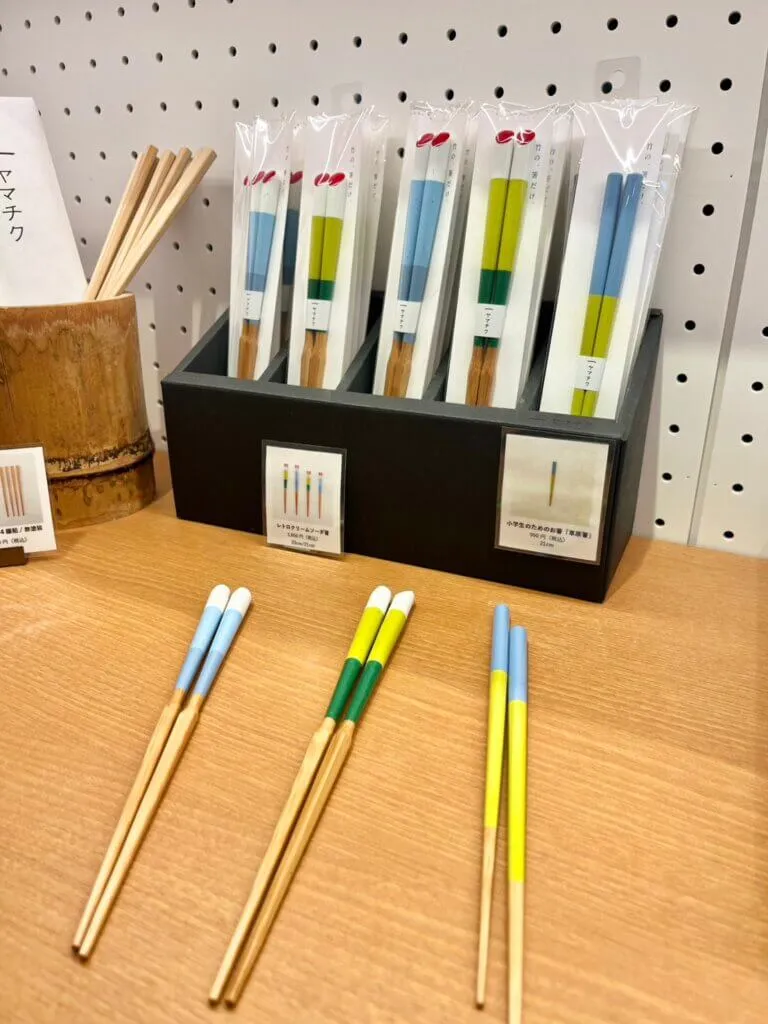 As a kid I had a pair of chopsticks that looked like colored pencils (I bet some of you did too!),
and these cream soda-inspired chopsticks are just as adorable!
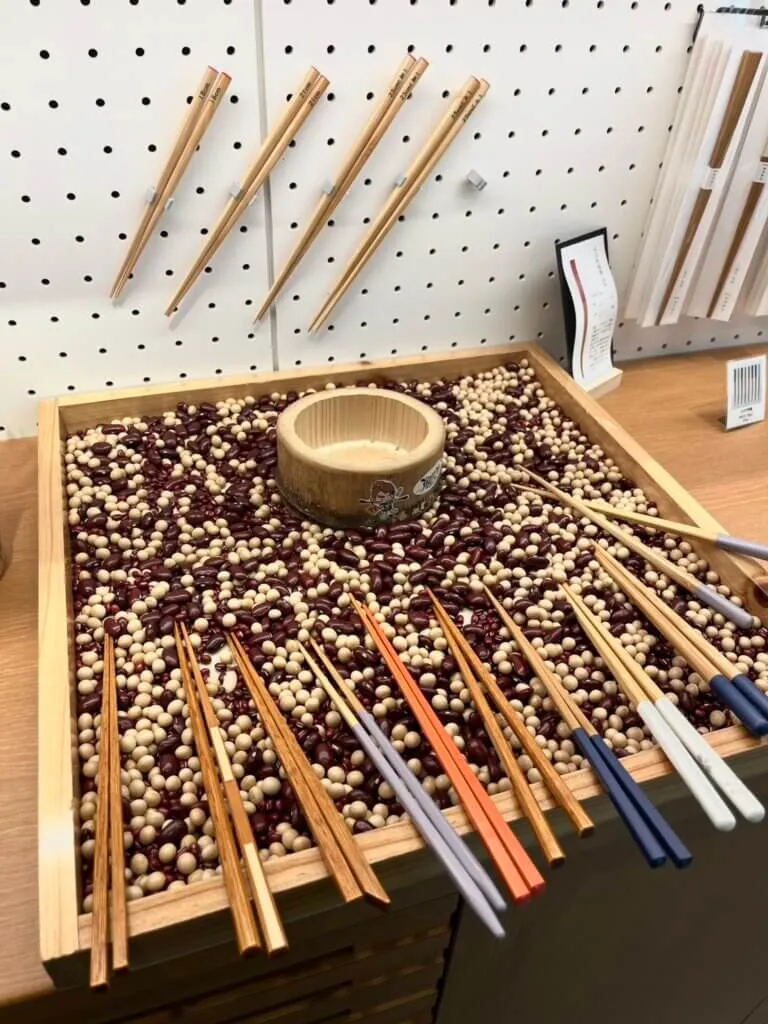 You can test how they feel by actually picking up beans with them.
It’s amazing how easily you can grab them one after another!
There are several kinds of children’s chopsticks too, so it’s a great place to find your little one’s very first pair ★
I picked some up as souvenirs for my son and daughter ♩
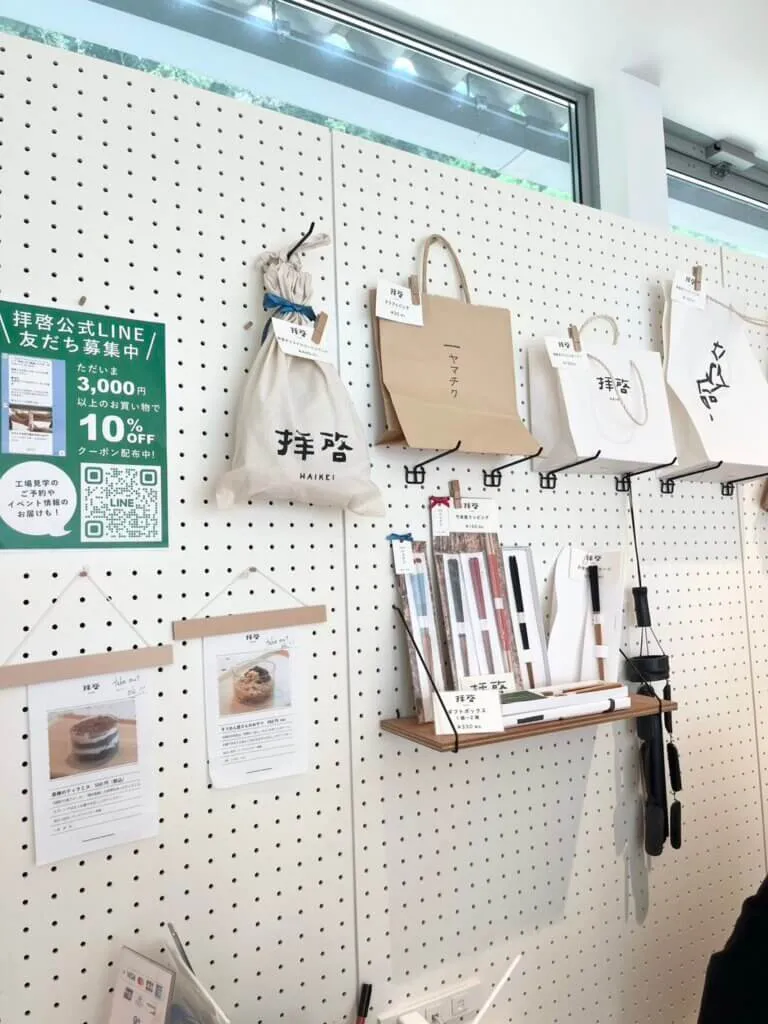 Gift wrapping and name engraving are available too.
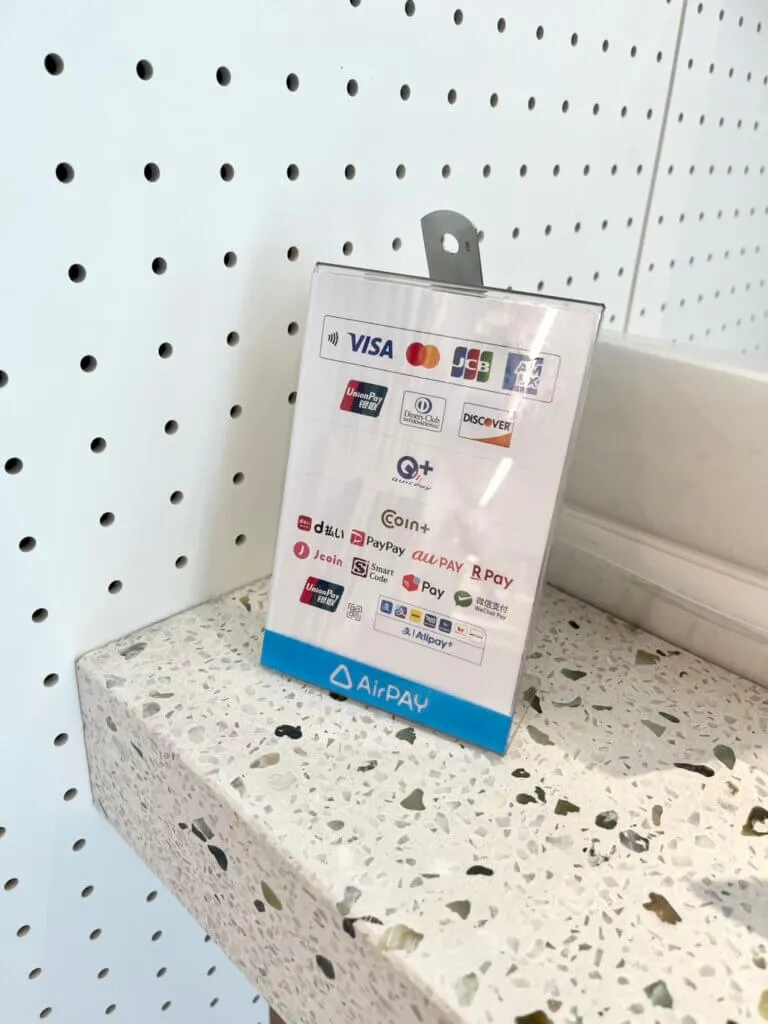 Payment is easy, with cash, credit cards, and various cashless options all accepted.
Haikei Highlights
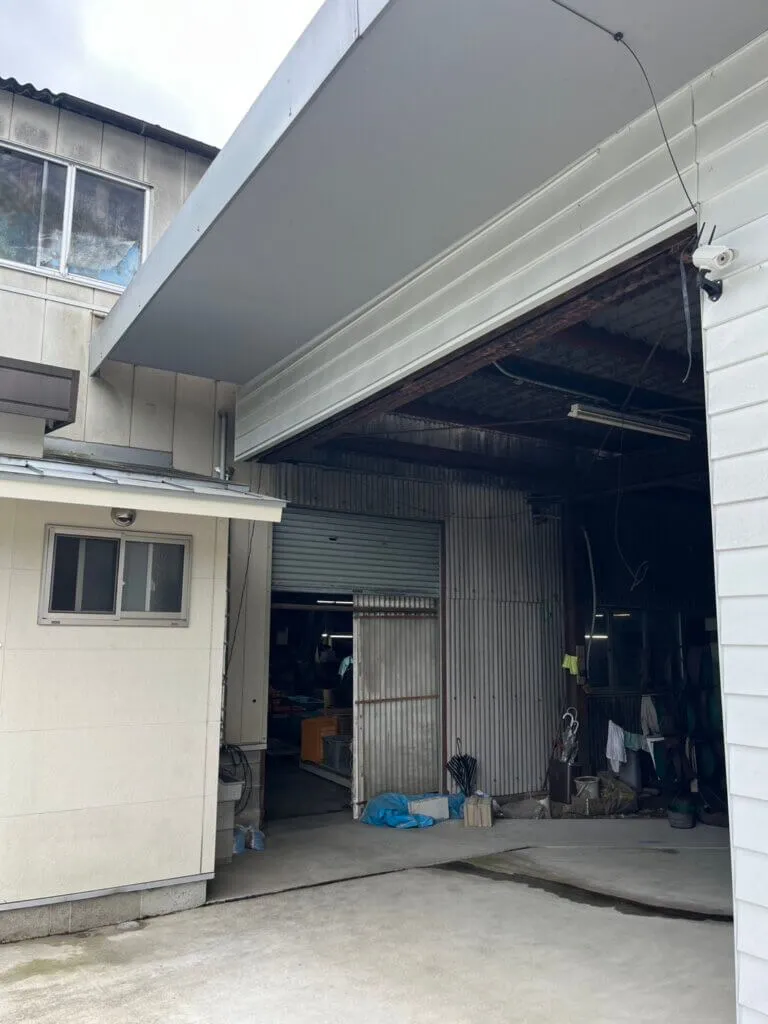 After paying at the register, you’ll head from the shop over to the factory.
On the day of my visit, our guide was none other than fellow Sarukuma writer Gachako (^○^)
Gachako also works in PR for Yamachiku!
Since Gachako guides factory tours as well, you might just get to meet them…?
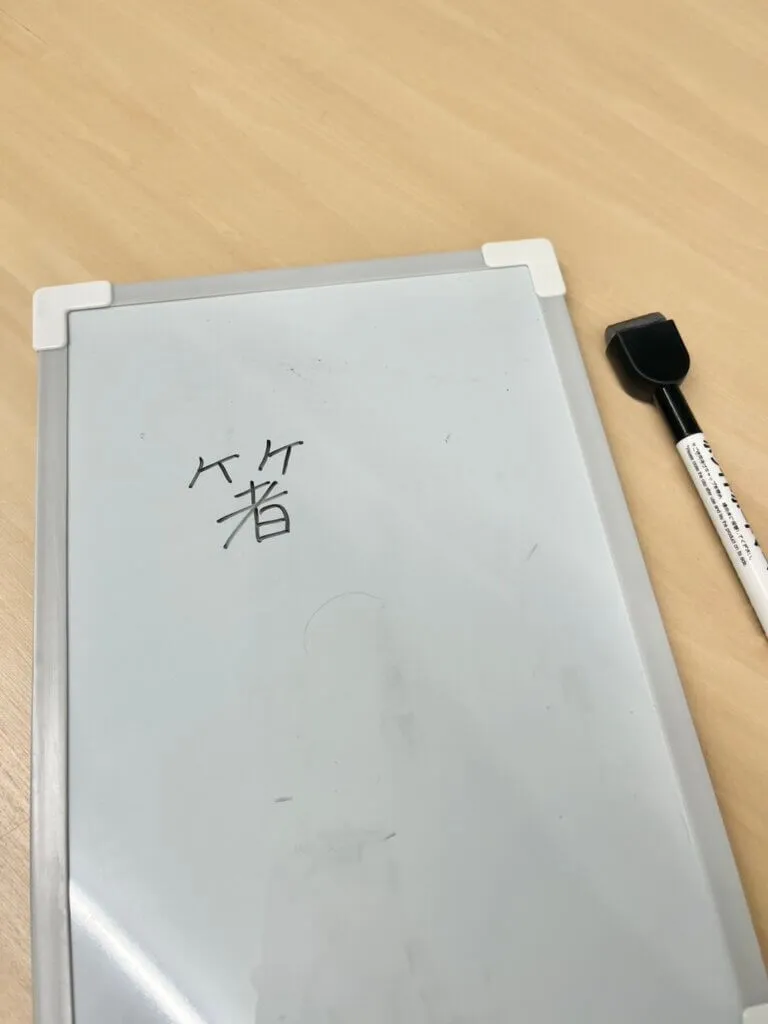 “Before we start the tour… please try writing the word ‘hashi’ (chopsticks) in kanji!” I was told, as a pen was handed to me.
What?! That was so sudden! LOL
I wrote it out, mumbling “I think it looks something like this…” and somehow got it right!
It turns out the kanji for chopsticks, 箸, is connected to one of the reasons Yamachiku has stayed devoted to making only bamboo chopsticks.
As for what that reason is… you’ll have to join the factory tour and hear it for yourself (^^)/
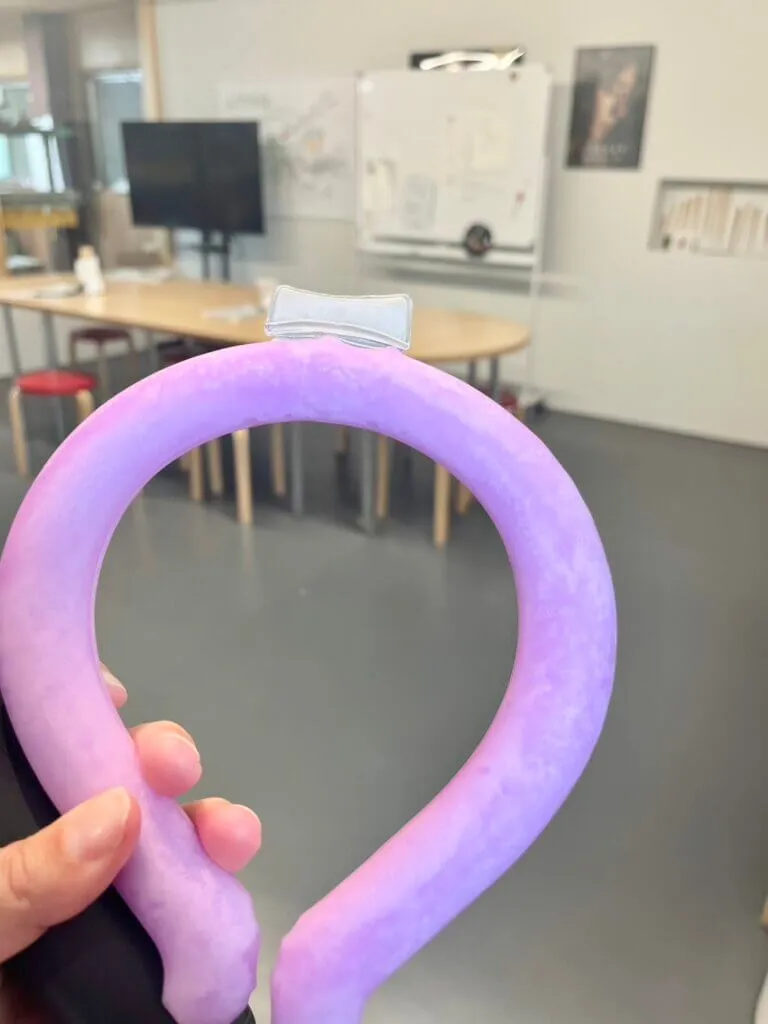 It gets hot inside the factory, so it’s a nice touch that they lend you a cooling neck ring.
Bringing a towel to wipe off sweat is a good idea too!
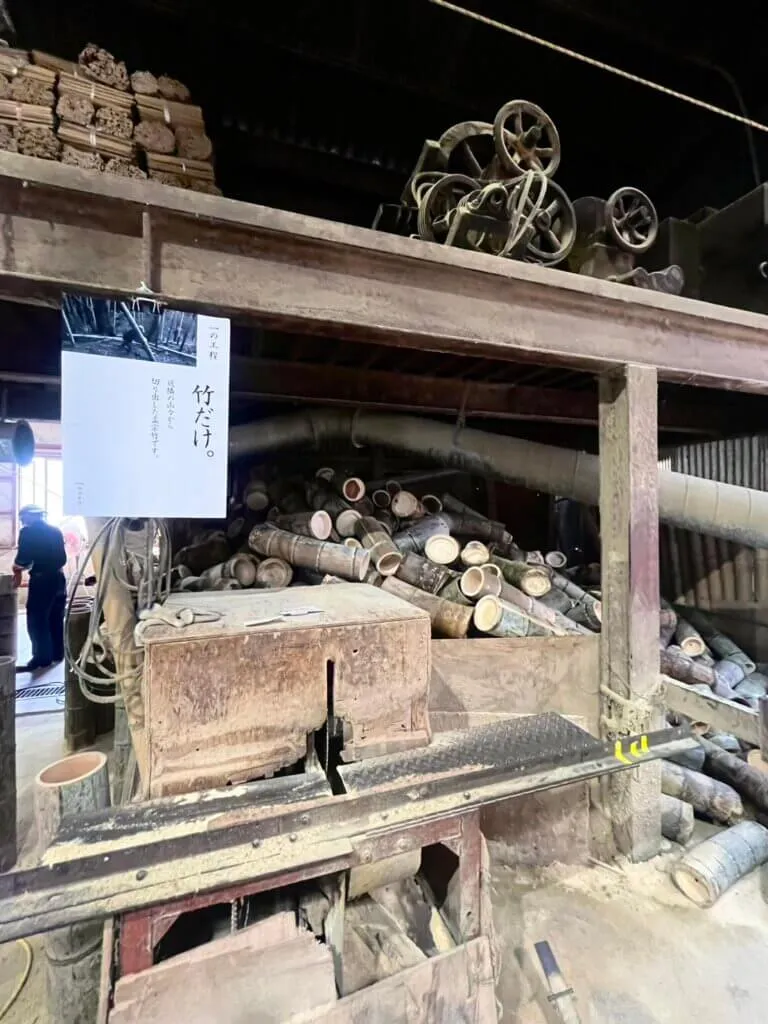 First up, we were shown the raw material: bamboo.
Yamachiku uses a variety called moso bamboo.
It’s grown around Yame and Nagomi, about 30 minutes from Nankan Town.
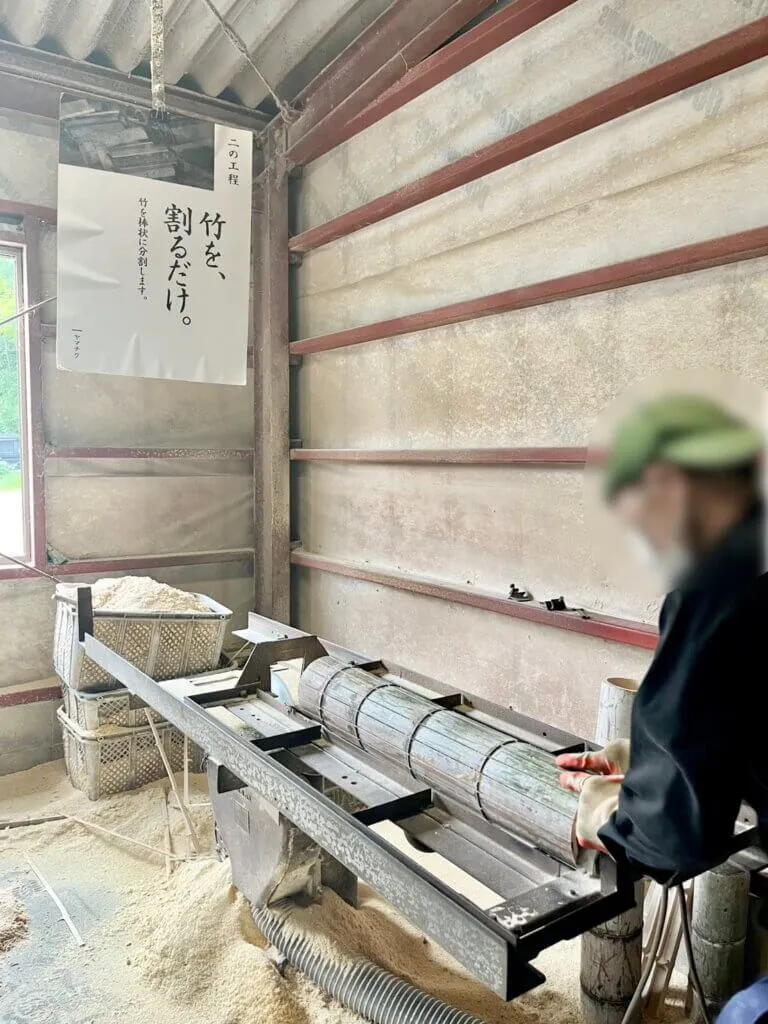 Next comes splitting the bamboo.
A specialized machine scores the bamboo in an instant.
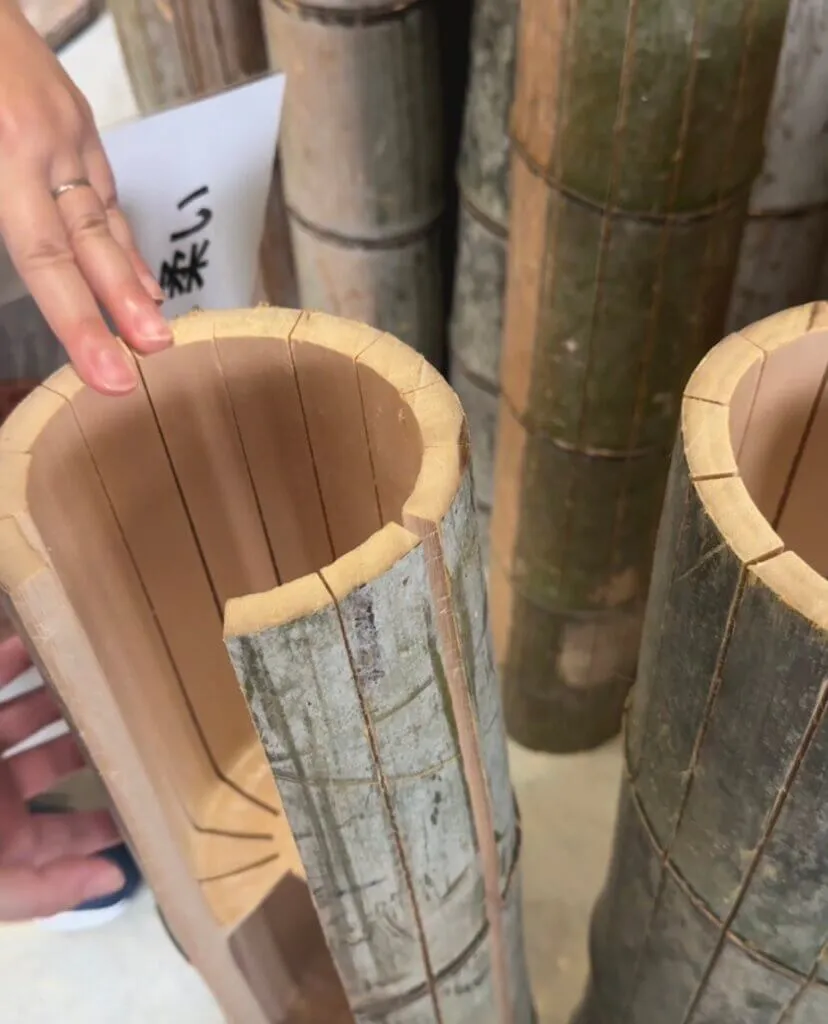 At this stage, the bamboo has only been scored.
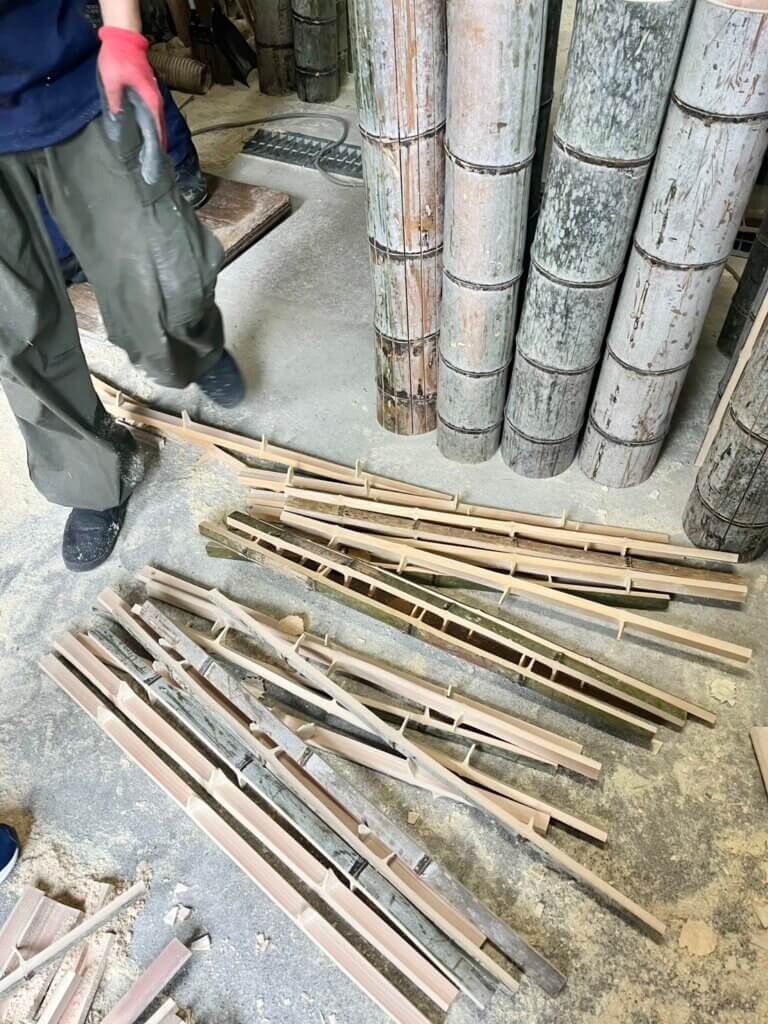 By striking the scored bamboo against the ground, it splits cleanly along the cuts.
But after splitting, the pieces still have nodes and uneven thickness.
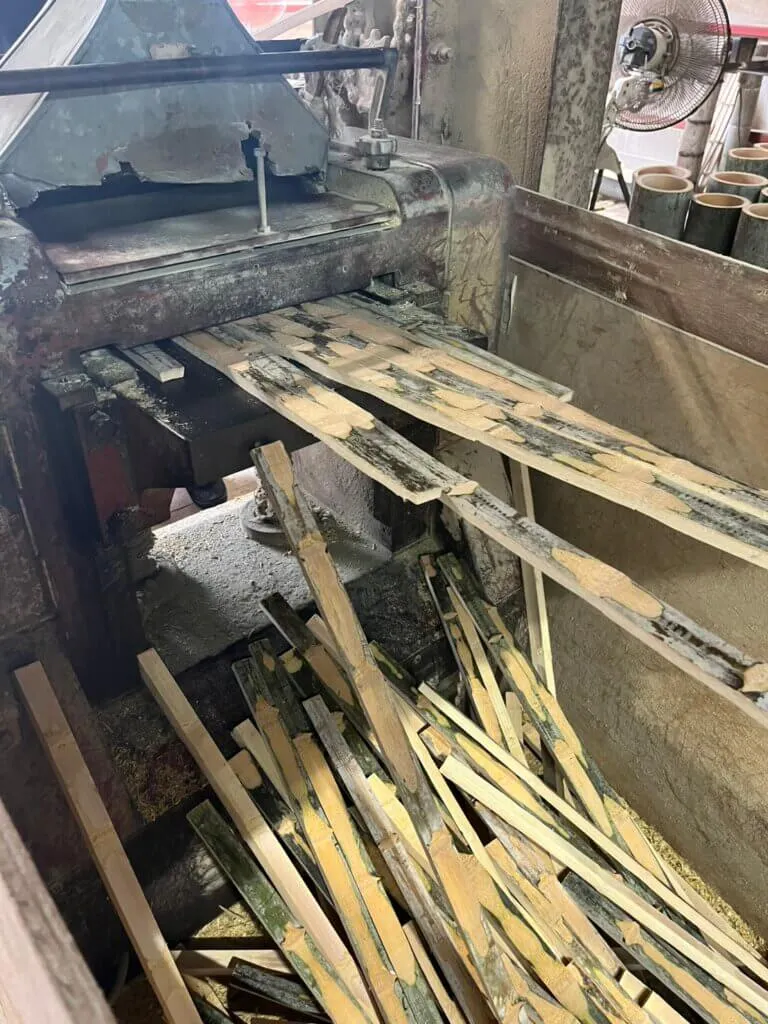 In the next step, the nodes are cut away and the thickness is evened out.
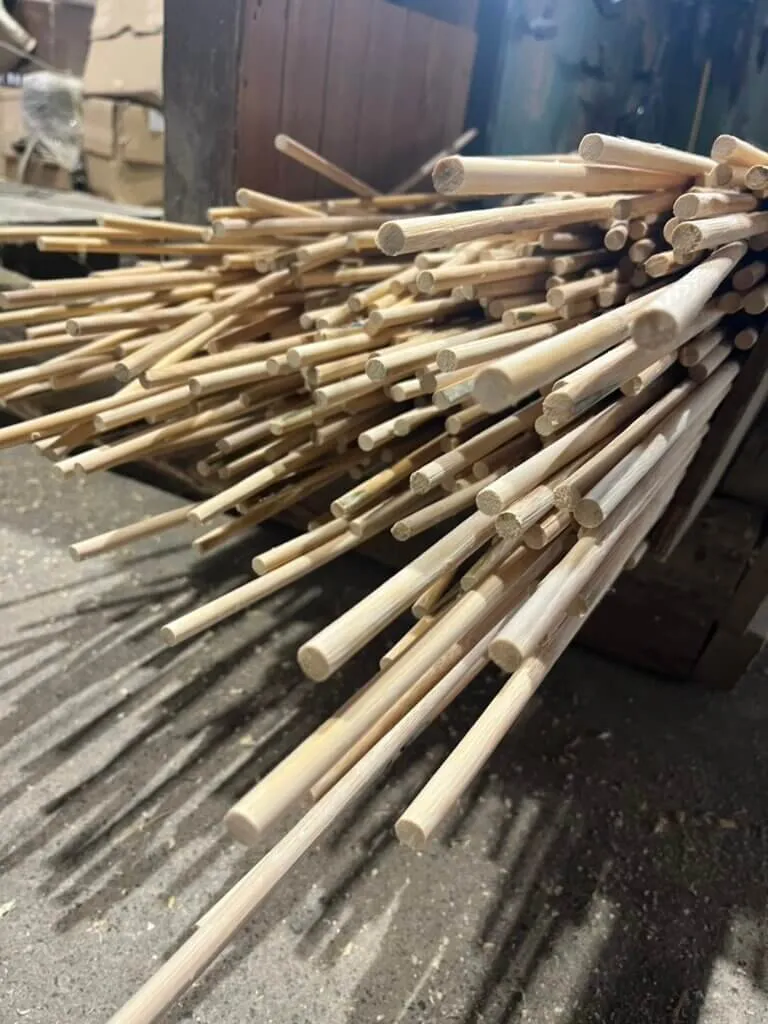 Then the pieces are cut into round sticks.
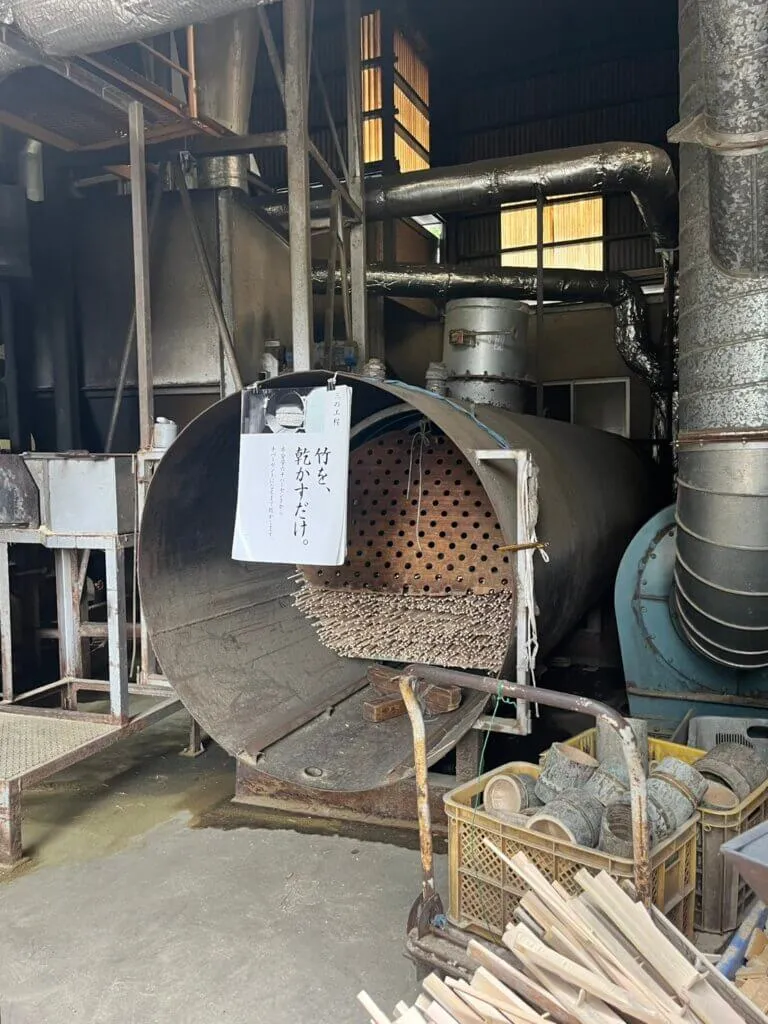 Just when I thought they were gradually turning into chopsticks, a surprising step comes in.
Bamboo actually holds a lot of moisture.
If it’s processed as is, it can grow mold or warp as it dries.
The drying process reduces the moisture content from 60% to 10%, which allows the bamboo to be stored long-term and worked properly.
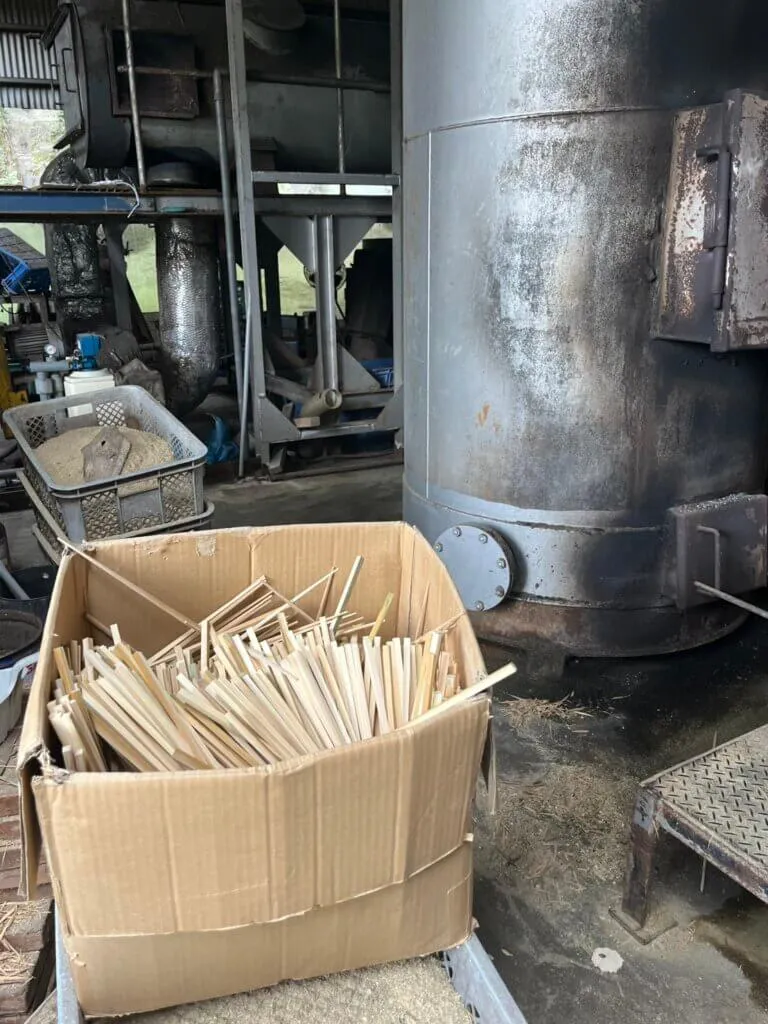 The fuel for drying comes from bamboo offcuts and chopsticks that didn’t pass inspection.
Nothing goes to waste, and I could really feel their commitment not only to craftsmanship but to the environment as well.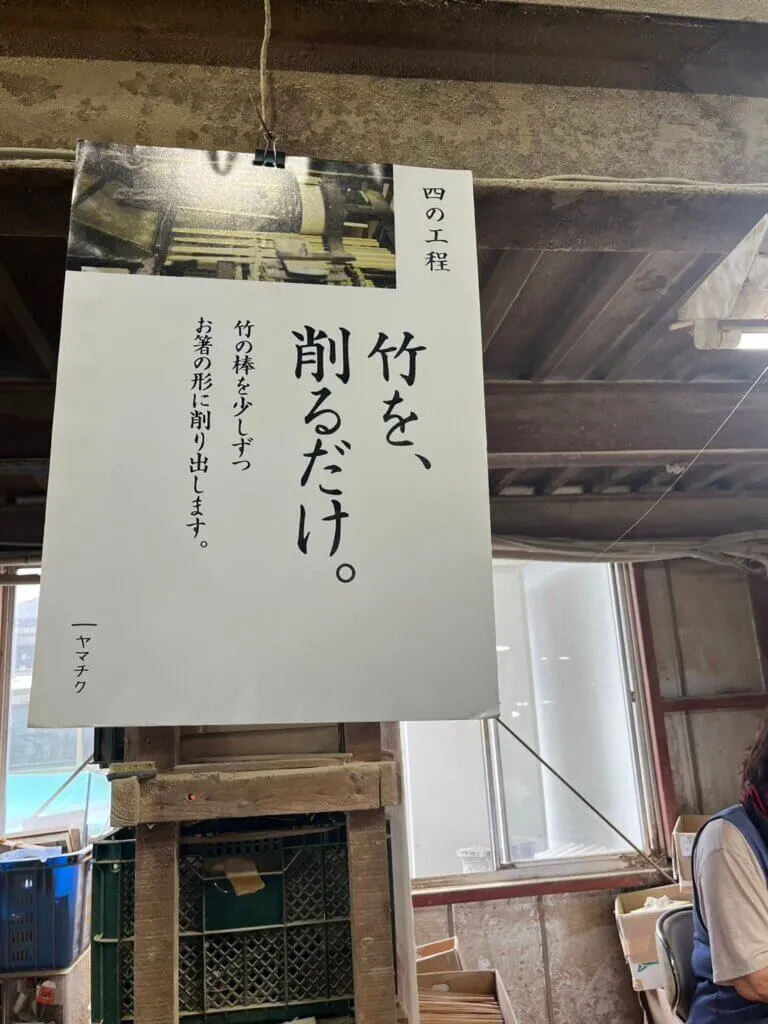 Once dried, the bamboo finally starts taking the shape of chopsticks.
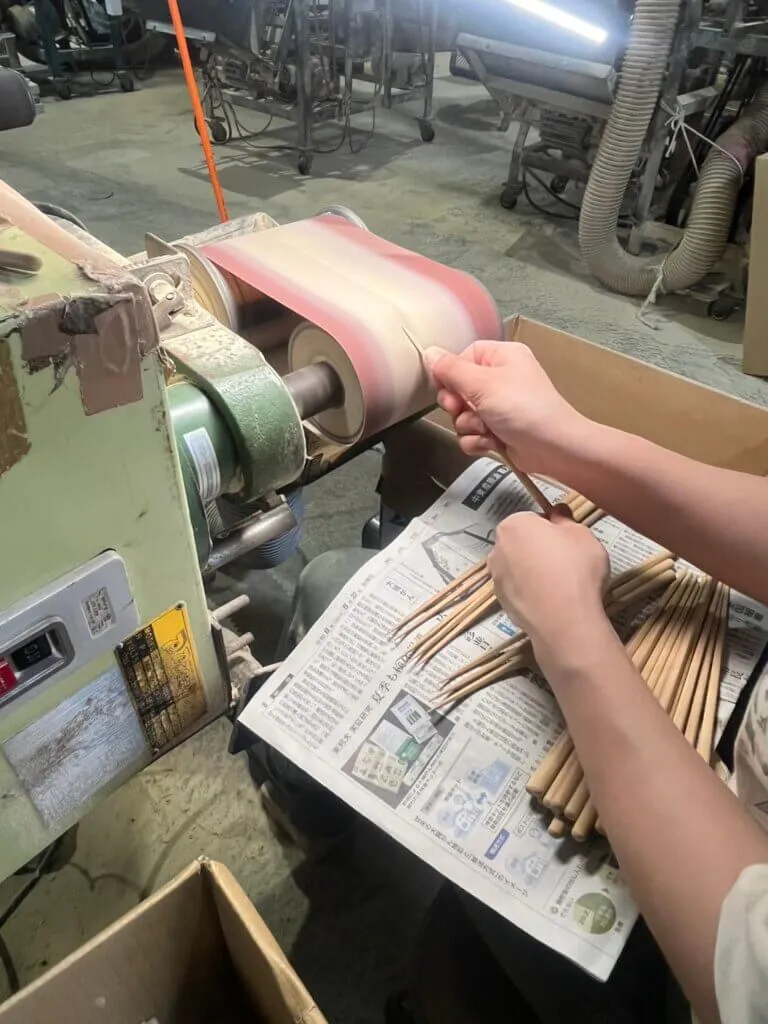
The sticks are shaped against a sander, but it’s not just simple sanding.
Bamboo is built so that the part closest to the outer skin has the densest, strongest fibers.
Watching the craftsperson work with quick, skilled hands while judging just how much of the outer layer to leave was true artisan skill!
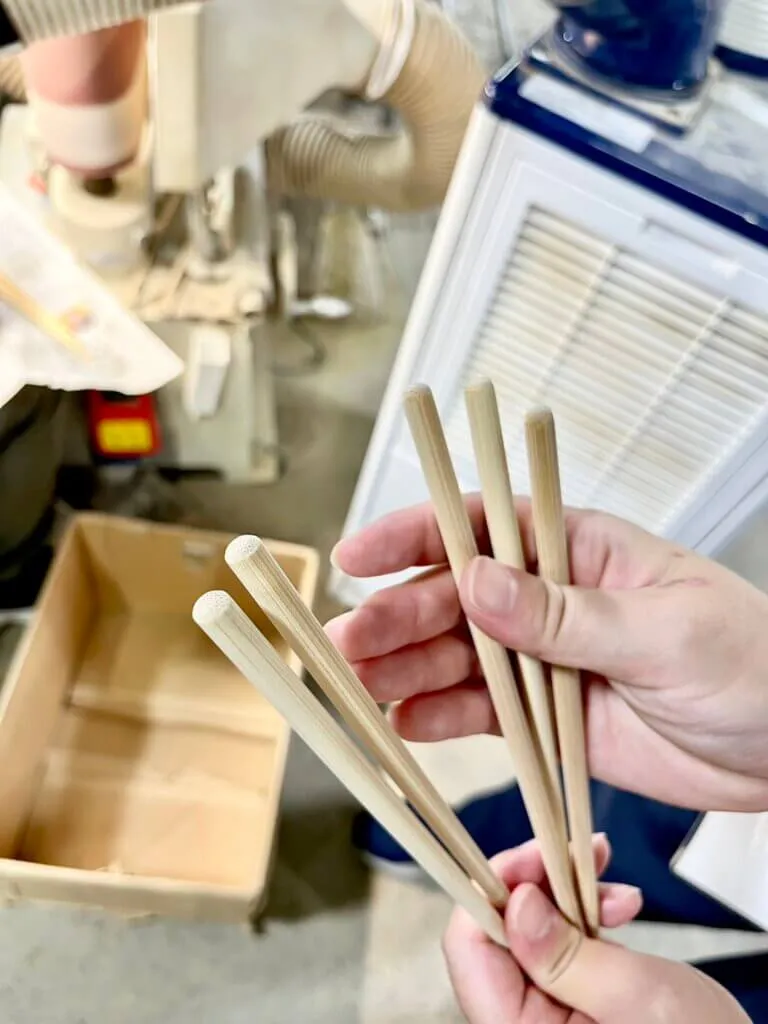 This is the sanding of the upper (handle) section.
Before processing, you could see the ridges and feel the roughness, but afterward it’s so smooth you’ll want to keep touching it forever.
 And this is the tip.
It’s rotated round and round while being shaved thin, so it feels pleasant in your mouth.
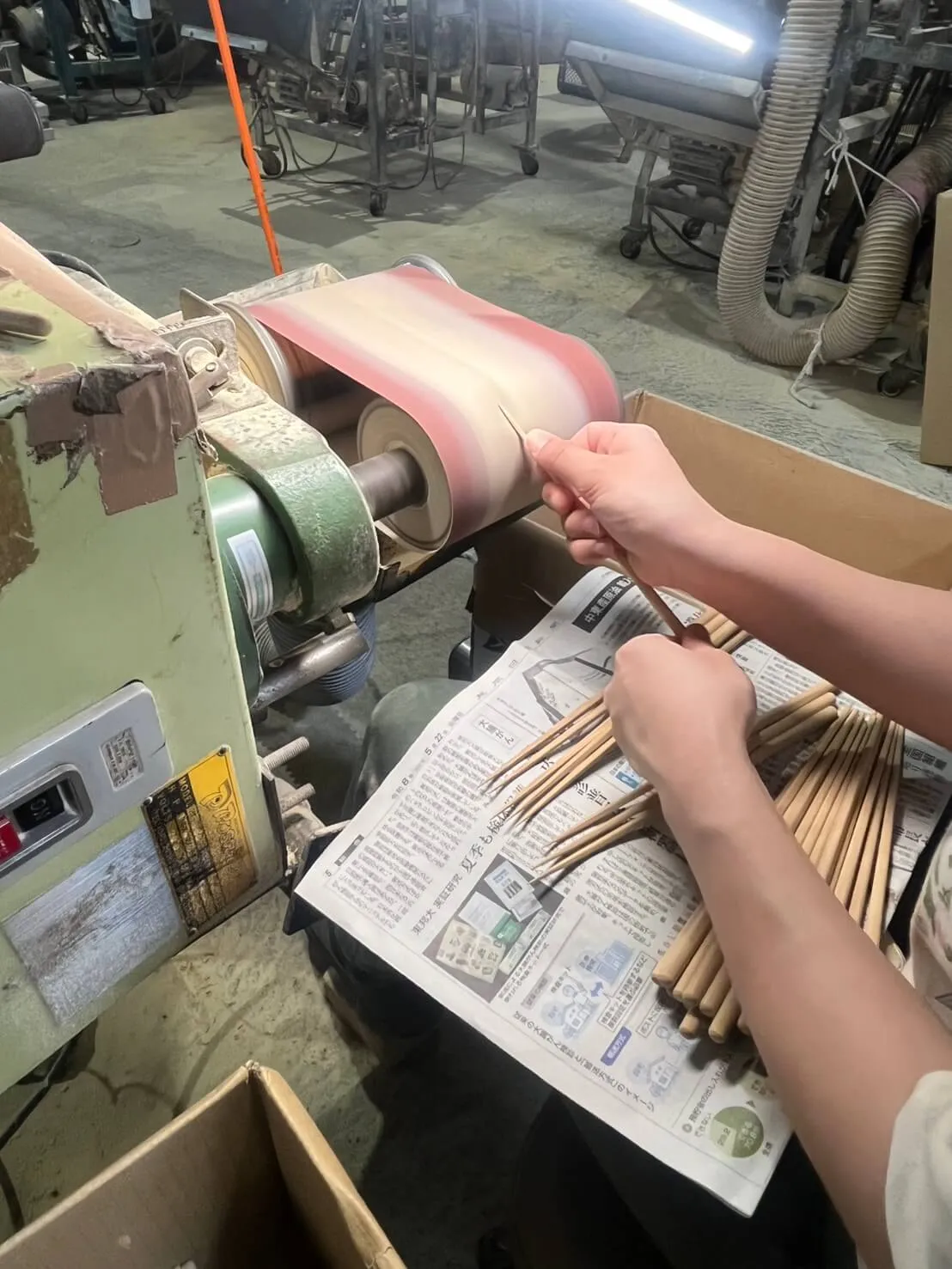
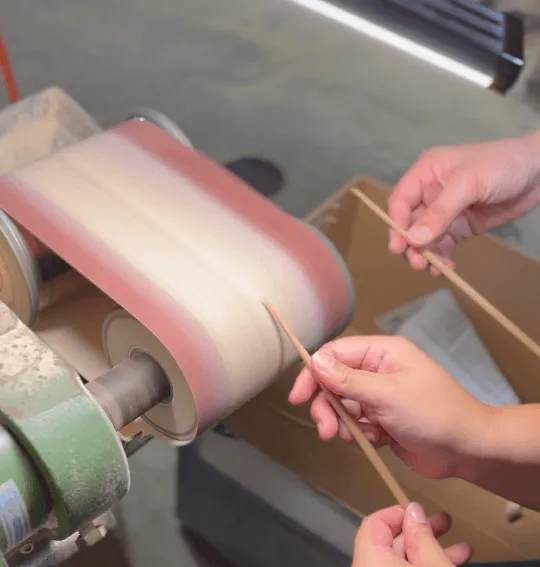 The Yamachiku factory tour includes a mini hands-on experience, and this time I got to try this very step!
You press the tip fairly firmly against the sander while twirling it with both hands.
When I focused on twirling with both hands, I didn’t press hard enough and it barely got shaved. But press too hard and it shaves away fast! LOL
They say the tasks that look easiest are often the hardest, and that was absolutely true here.
When small children join the tour, the activity is switched to something like painting for safety, so families can relax and enjoy (^^)/
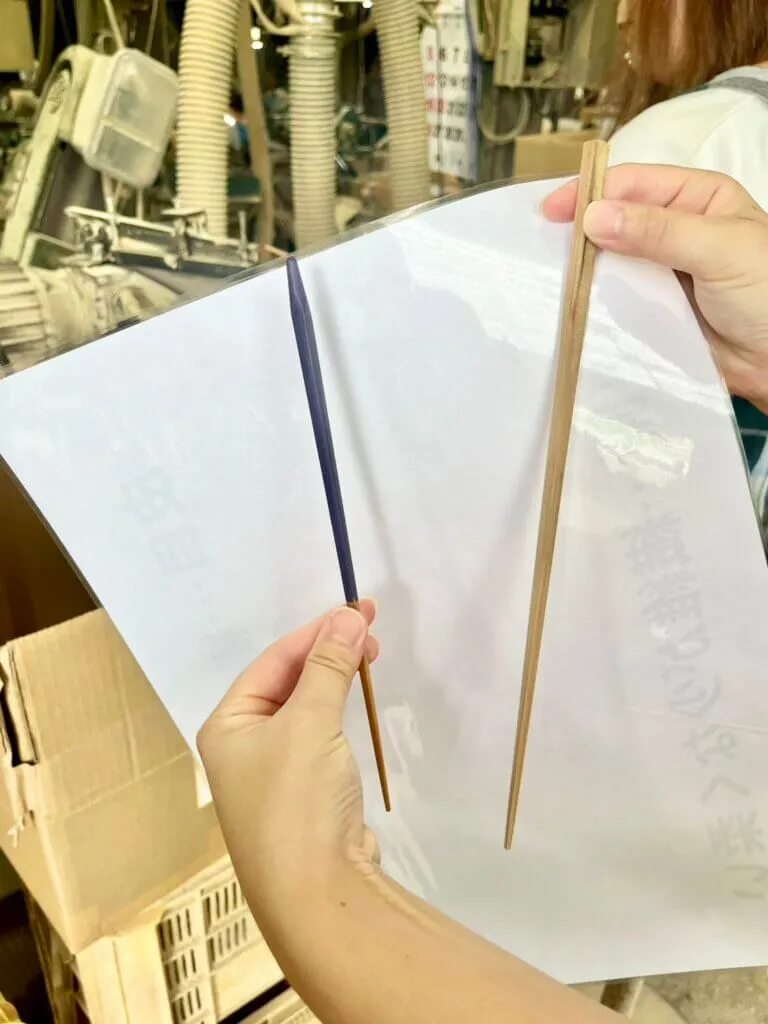 Depending on the type of chopsticks, they’re eventually shaped down to about this thin.
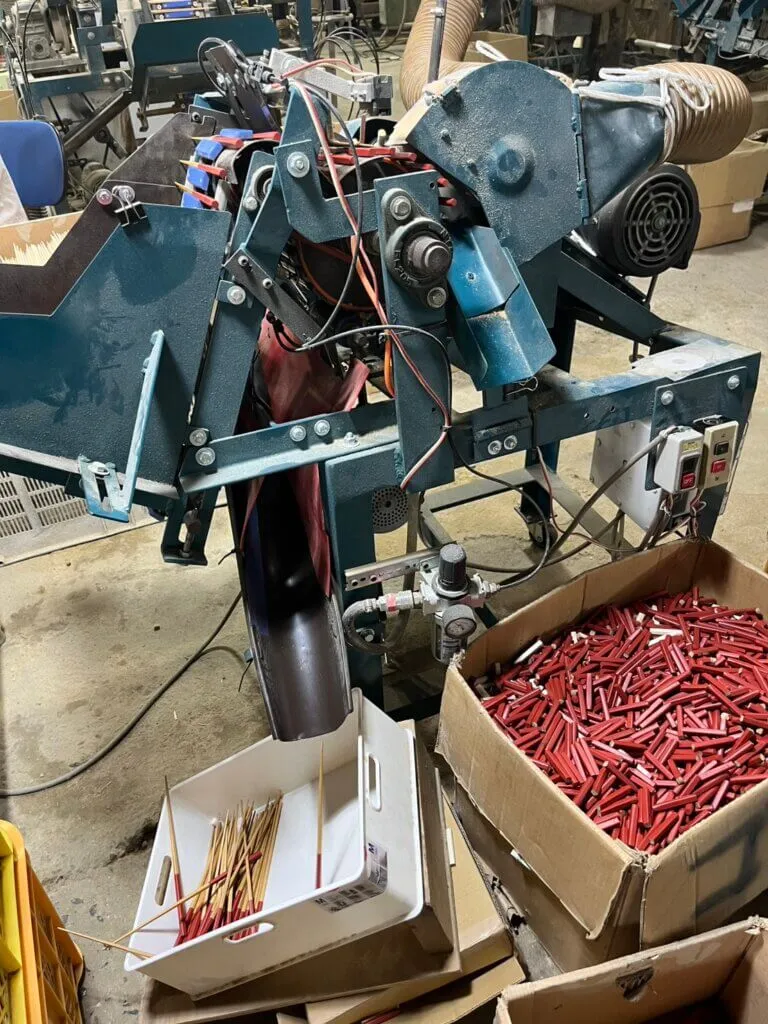 Here, the chopsticks are trimmed to an even length.
The trimmed-off ends are reused as toys for kids or burned as fuel.
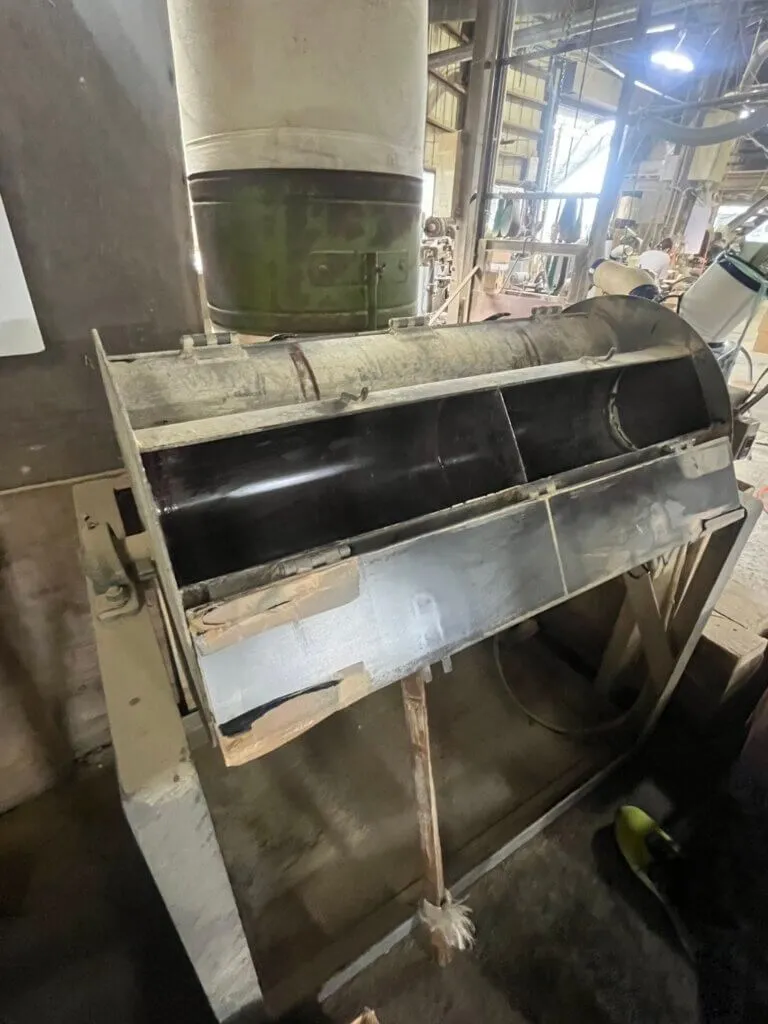 Finally, they’re polished in this machine.
The chopsticks go inside, and when it’s switched on it spins round and round. The centrifugal force and the chopsticks rubbing against each other make them silky smooth.
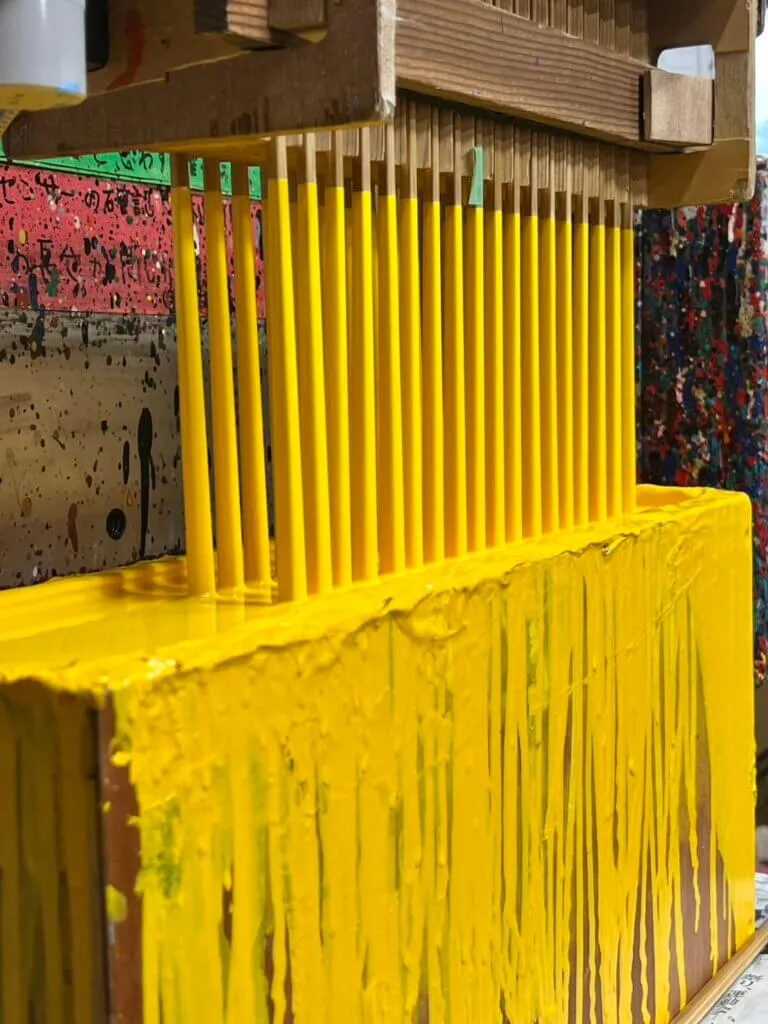 Next is painting.
A special machine paints large batches at once,
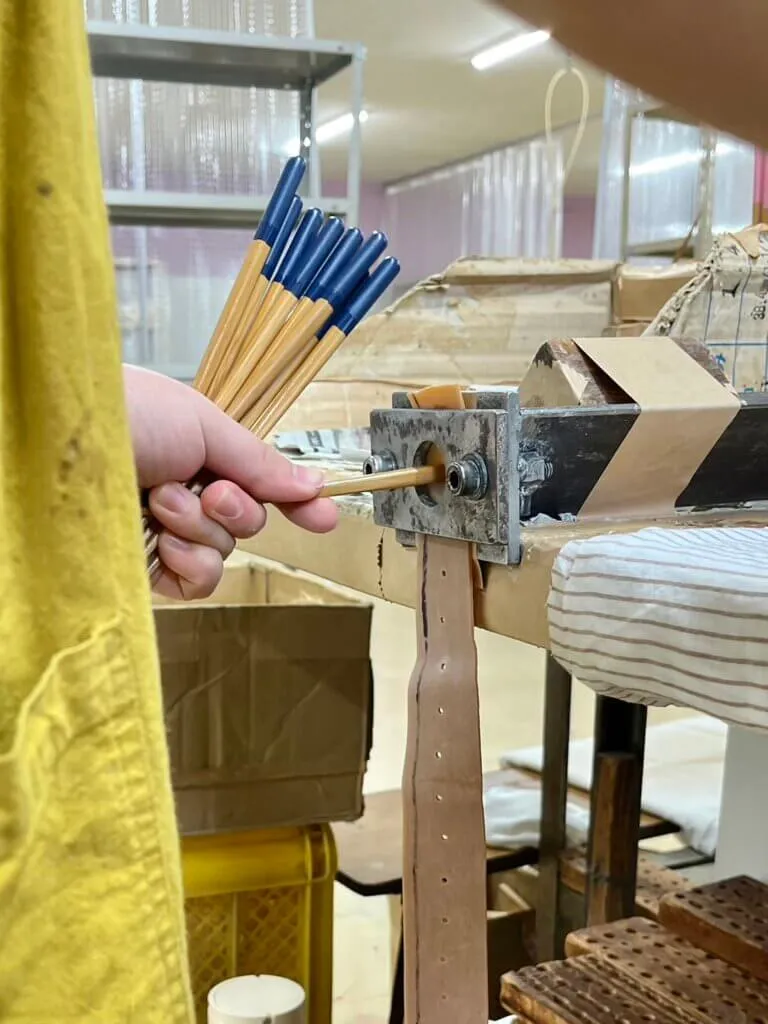 while the coating applied on top is sometimes done by hand, one chopstick at a time.
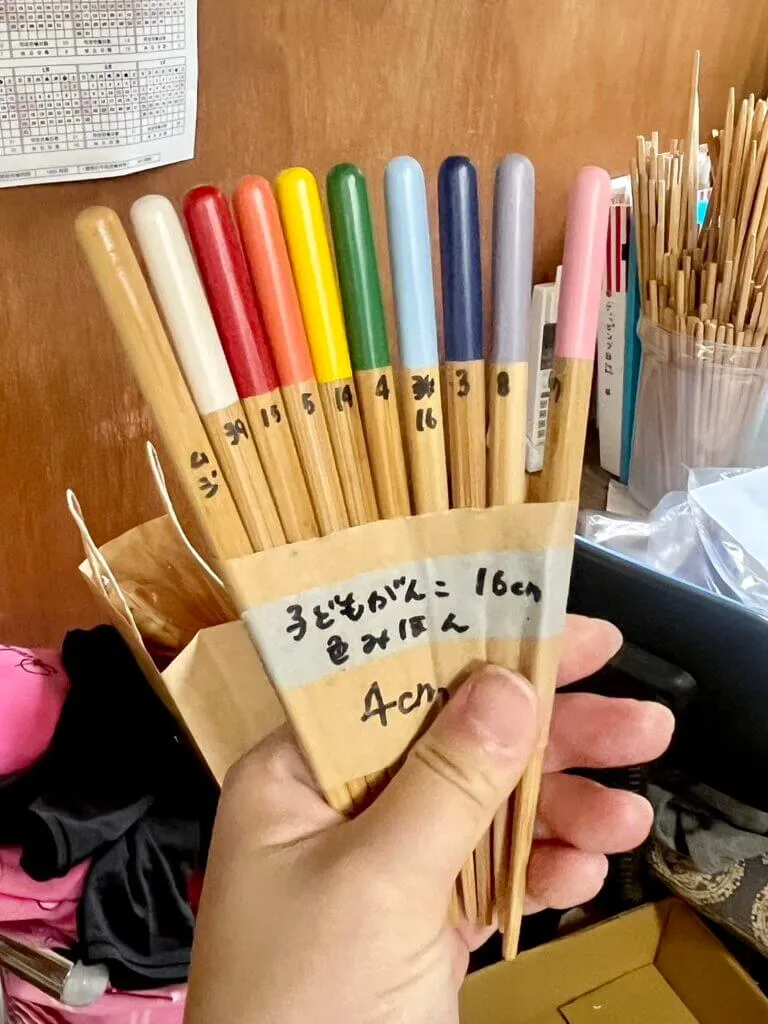 There are about 40 colors to choose from, and the kids’ chopsticks turn out this cute!
Picking your own favorite color is half the fun.
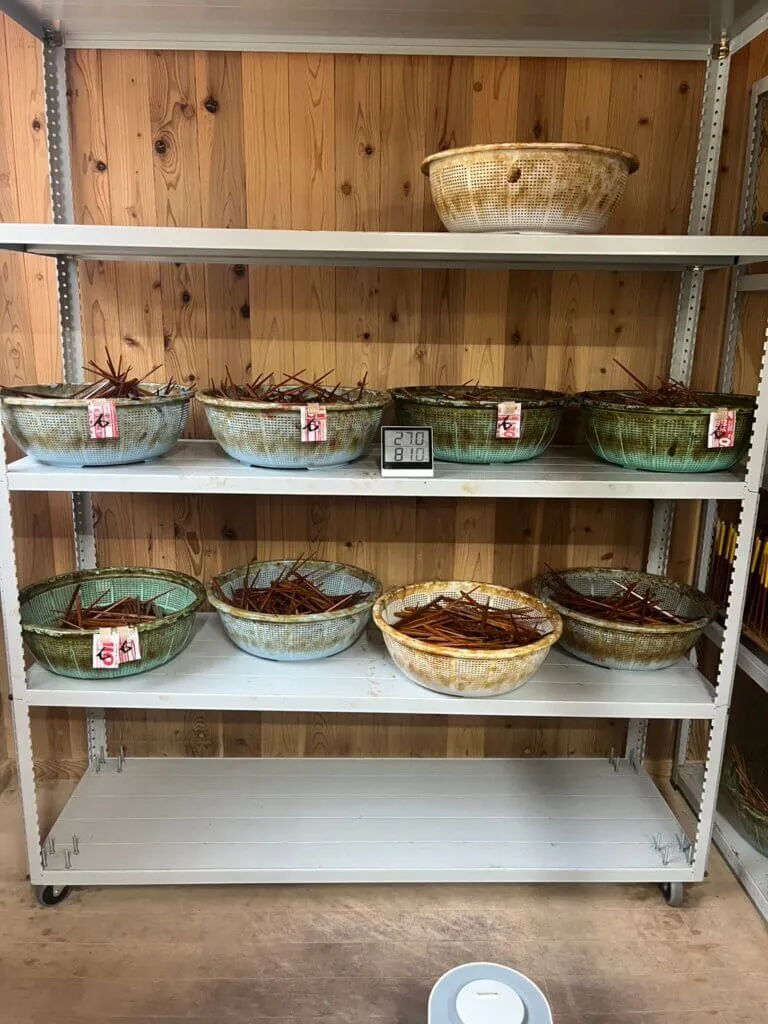 Also, urushi, a natural Japanese lacquer, needs around 70% humidity to dry properly.
Lacquered chopsticks resist water and oil, and they’re said to gain a lovely translucent sheen the more you use them, which is why many people choose them as gifts.
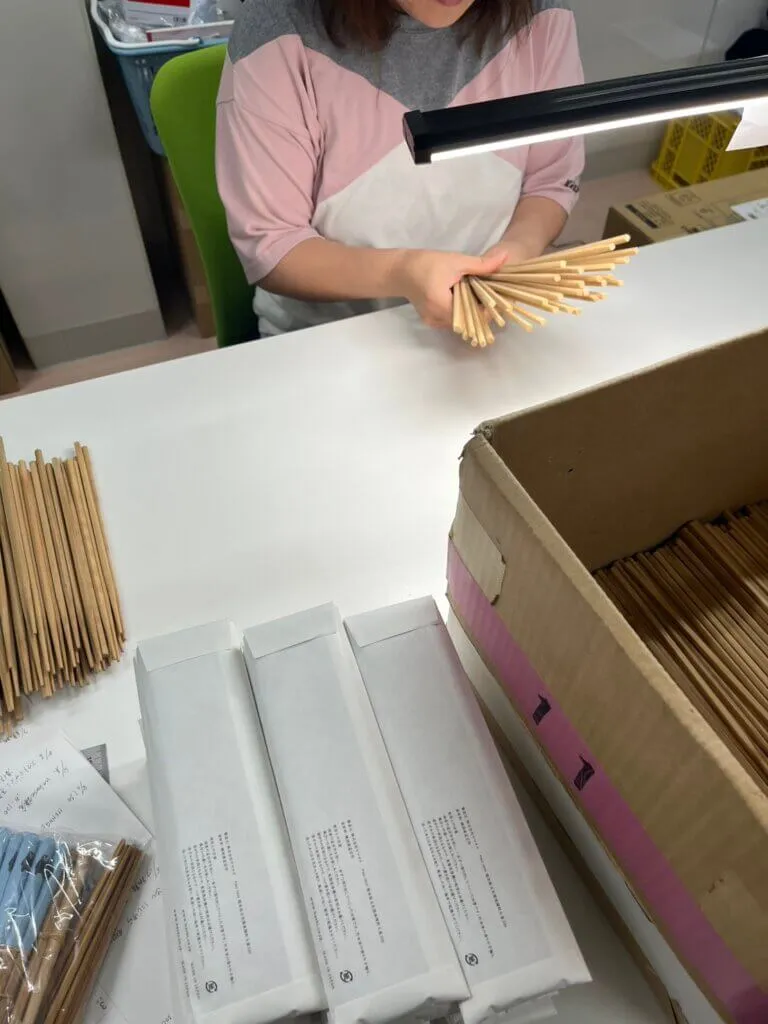 Last, we watched the inspection process.
During my visit, they were inspecting susutake (smoked bamboo) chopsticks.
Every single chopstick is checked by eye for tiny dirt marks, stains, warping, and cracks you’d barely notice without looking closely. That’s how such high-quality chopsticks reach our tables.
These susutake chopsticks were the ones handed out with takeout food at that Yamachiku event I went to.
That was my very first time using Yamachiku chopsticks. I was so impressed by how comfortable they were that I took them home, and I still use them to this day.
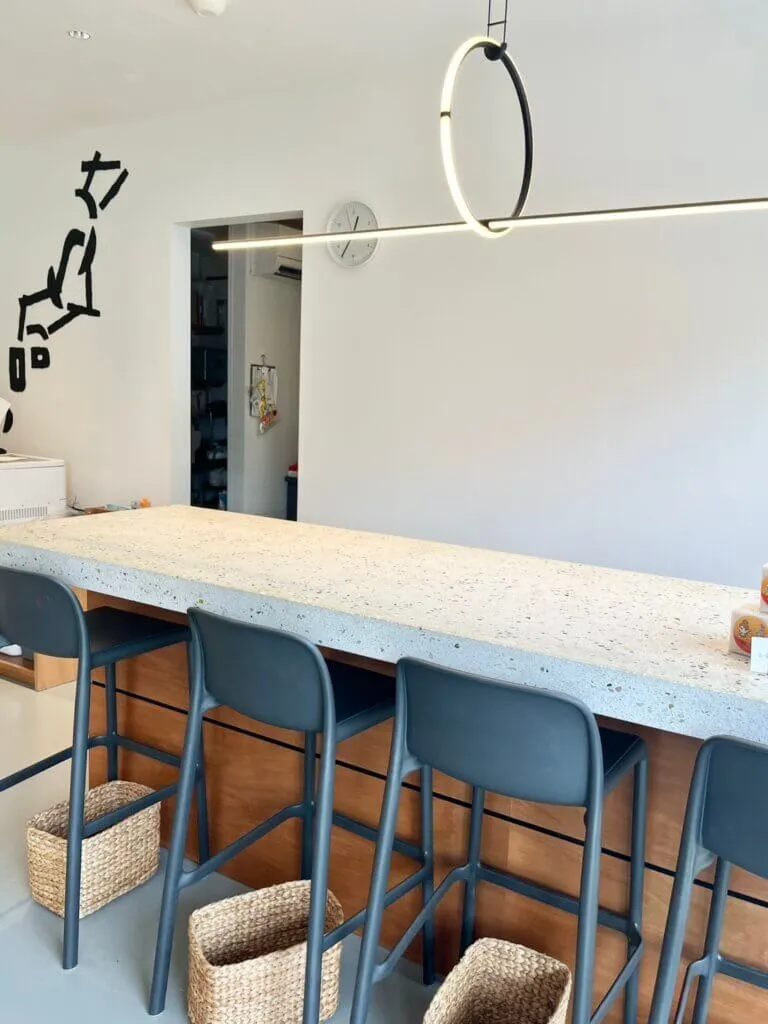 Everything was new to me, and the 60 minutes flew by.
Getting to see the artisans’ delicate handwork and their passion for chopstick-making up close is something only a factory tour can offer.
With my chopstick enthusiasm at an all-time high after the tour, it was time to put them to use over lunch!
(Lunch is not included in the factory tour. I let the staff know before the tour started that I’d be having lunch afterward.)
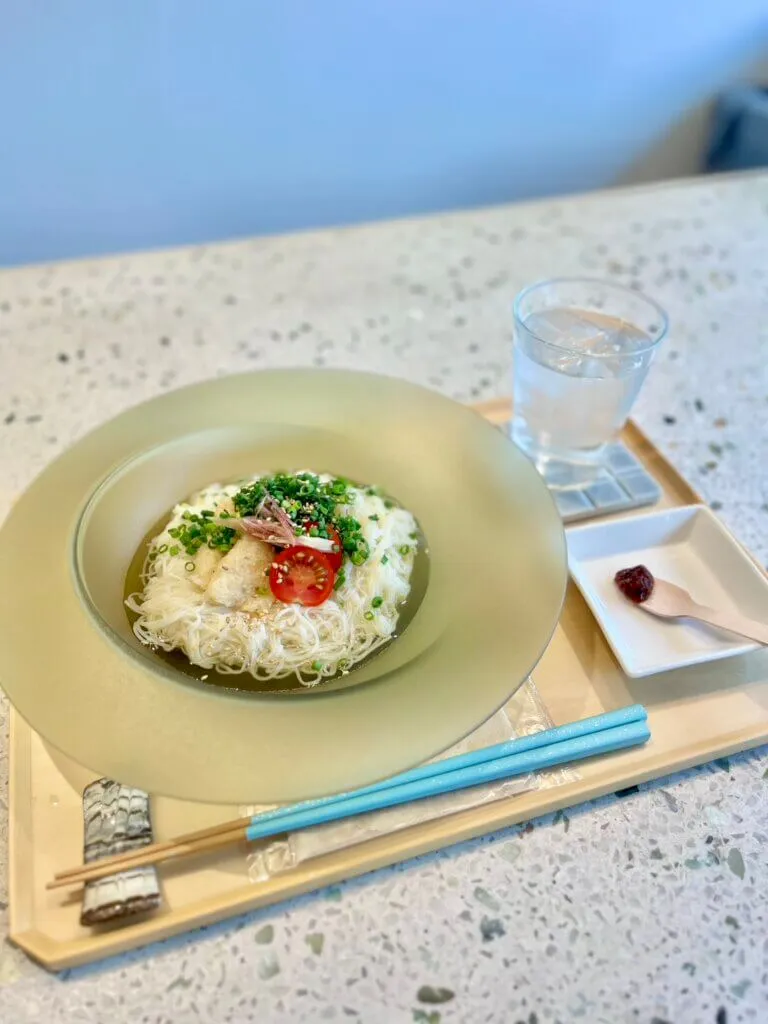 These two dishes are new additions to the summer menu:
・Bukkake Nankan Somen (chilled Nankan noodles with broth poured over)
・Chilled Tomato Dipping Pasta
With drink: ¥1,400 / Dish only: ¥1,000
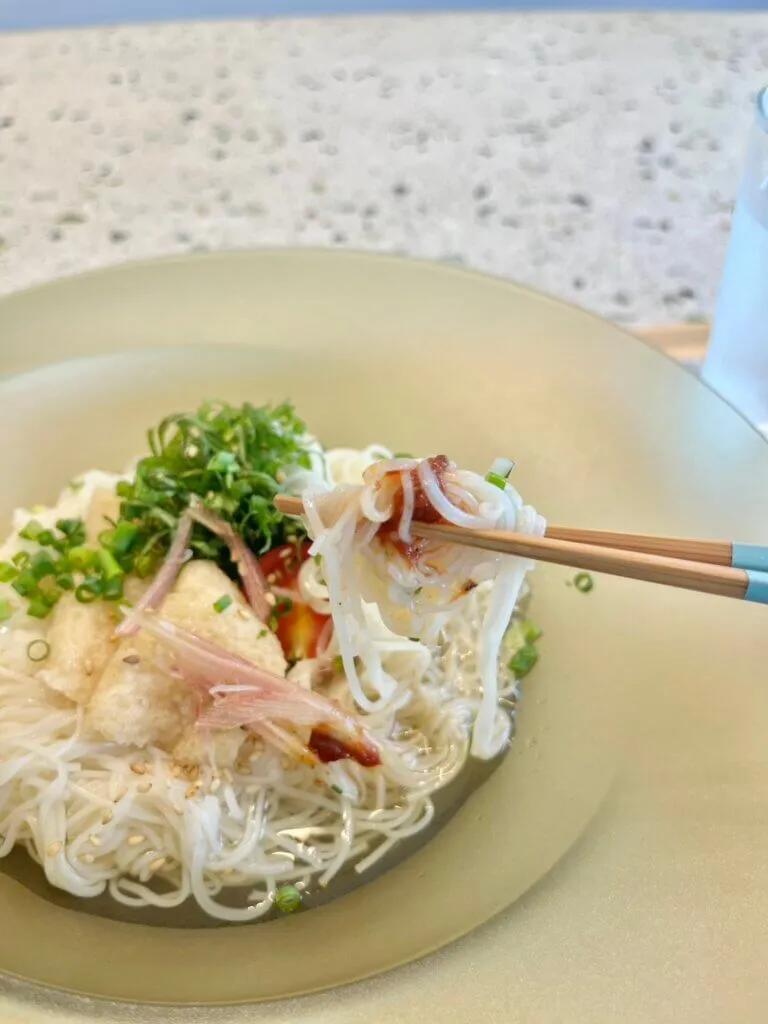 Eating Nankan somen while savoring how wonderful these chopsticks feel was such a treat!
The Nankan-age (the town’s famous fried tofu) bursts with savory flavor with every bite, and the yuzu-tomato sauce for switching up the taste is fresh and fragrant.
The whole dish is light and refreshing, perfect for a hot day ♩
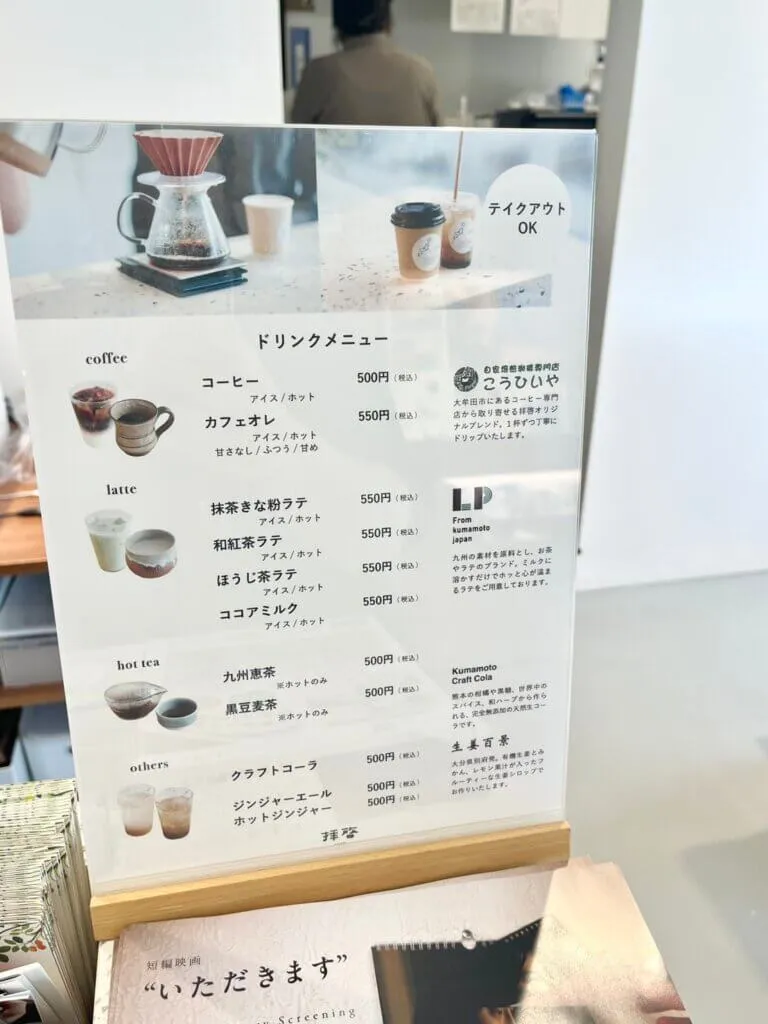 There’s a great selection of drinks, too (^^)
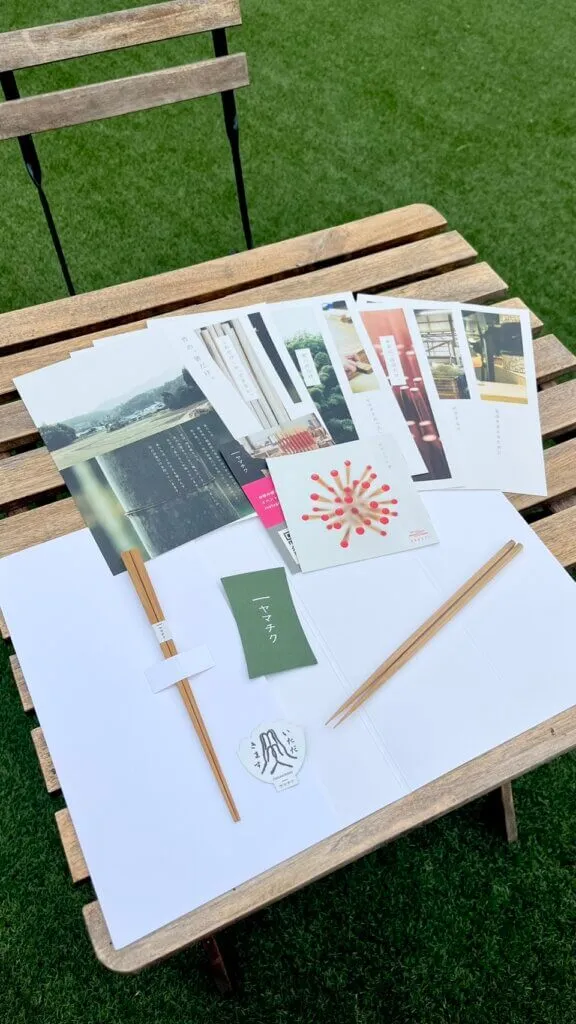 On the factory tour, you get a pair of chopsticks as a souvenir, separate from the one you work on during the mini hands-on experience.
You’ll also receive stickers and a booklet, so you can keep enjoying the memories of the tour once you’re back home.
Use Yamachiku’s bamboo chopsticks just once, and you’ll understand what makes them special.
Why bamboo? What makes them different?
On the factory tour, you’ll discover Yamachiku’s passion for craftsmanship and their unwavering devotion to bamboo chopsticks, along with the reasons so many people choose them.
Watching a single stalk of bamboo transform into chopsticks is a wonderful learning experience for kids, too.
If you’re visiting Kumamoto with your family, be sure to add this factory tour to your itinerary (^^)/
We update our Instagram every day!
Sarukuma shares information on lunch spots, parks, indoor play areas, and more for families in Kumamoto.
We’d love for you to follow us (*´∀`*)

Article Writer
Sarukuma Editorial
Sarukuma Editorial is a small team of locals based in Kumamoto, Japan, sharing the hidden gems, hometown flavors, and seasonal experiences that make our region special. We write the kind of guide we wish we had when showing friends around — honest, practical, and made by people who actually live here.
Popular Ranking
-
Inside Cafe106, Minami-ku’s Cozy New Hideaway with Kumamoto’s Best Peach Frappe
Food & Restaurants
2026.4.27
1 -
Minamiaso Fureai Zoo Fairy Tale (Takamori, Aso) — A Hidden Gem Where You Can Cuddle Goats, Rabbits, Chicks & More!
Outing Spots
2025.12.13
2 -
Costco Kumamoto Mifune Warehouse: Grand Opening April 1st – A First Look at Kumamoto’s Newest Wholesale Destination (Mifune Town)

Outing Spots
2021.3.11
3 -
Shiroyama Park in Nishi Ward, Kumamoto City — Free Parking, Baby Swings & a Toddler Zone Perfect for Little Ones!
Outing Spots
2026.1.19
4 -
CHEMIN D’INFINI (Chemin d’Infini): A Sophisticated Sweets & Cocktails Spot Open Only at Night | Chuo Ward, Kumamoto City
Food & Restaurants
2020.11.9
5 -
Tsukiji Shijukudai Park: A Family-Friendly Park with a Unique Rotating Chair Playground in Tamana City
Outing Spots
2021.4.30
6 -
Children’s Day in Kumamoto: 7 Family-Friendly Spots for Indoor Play & Hands-On Fun [2026 Edition]
Activities & Tips
2026.4.23
7 -
Imakin Shokudo: Famous Akaushi Beef Bowl at a Beloved Historic Restaurant in Aso, Kumamoto
Food & Restaurants
2020.9.18
8 -
Honda Kumamoto Welcome Park (Ozu Town): A Free Motorcycle Theme Park with Electric Bike Rides and Hands-On Exhibits!

Outing Spots
2026.3.7
9 -
Sarukuma Editors’ Picks! Top 7 Family-Friendly Spots in Kumamoto for 2025 — Where to Take Your Kids Tomorrow!
Activities & Tips
2025.12.27
10
Keywords
You Might Also Like
RECOMMEND
-
Ringodo Koshi Shop (Fukuhara, Koshi City) — Adorable Candy Apples Kids Love, Perfect as a Kumamoto Souvenir
Food & Restaurants
2023.9.3
-
Kanoko in Uki City: A Hidden Handmade Soba Gem Tucked Inside a Traditional Japanese Home
Food & Restaurants
2021.12.3
-
PARFAIT NA KIBUN – A Parfait Paradise in Central Kumamoto’s Hanabatacho District
Food & Restaurants
2020.12.9
-
equipment:FLOOR — Irresistible Curry & Asian Cuisine in a Hidden Kumamoto Hideaway (Kid-Friendly!)
Food & Restaurants
2021.2.6
Editor's Picks
PICK UP
Check latest info
on Instagram!

Check latest info
on Instagram!
Follow Sarukuma on Instagram for the latest food spots and event info!
- Search