Takemiya Programming School (Wakaba, Higashi Ward, Kumamoto City) — Where ‘I Did It!’ Builds Real Confidence! Small-Group Lessons Tailored to Each Child’s Pace, with Award-Winning Students in Under a Month!
2026.04.10
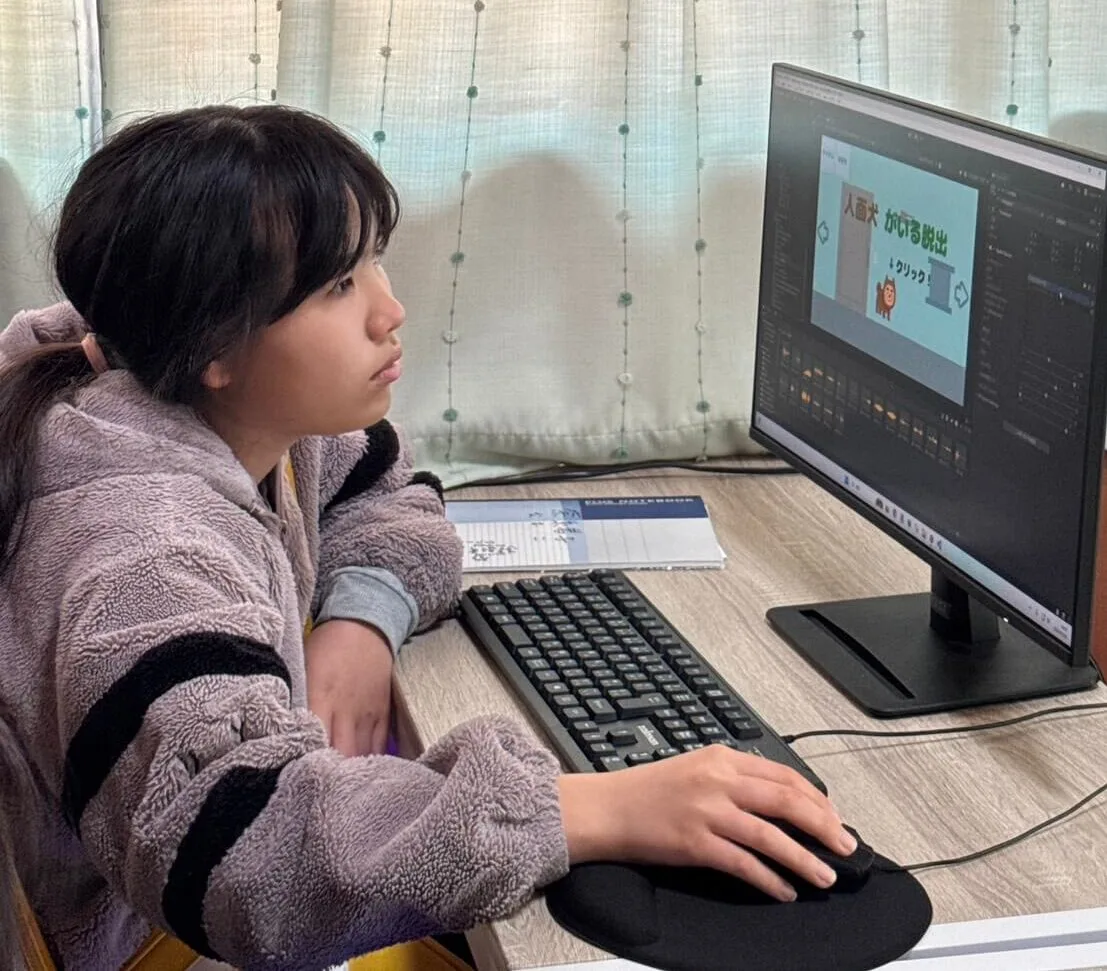
A SaruKuma writer visits Takemiya Programming School in Wakaba, Higashi Ward, Kumamoto City, and reports on the experience firsthand. Estimated price: from 600 yen. We’ve also rounded up family-friendly tips, access details, and opening hours.
Hello travelers! It’s Aikero, writer for [SaruKuma].
“I’d love for my child to learn programming, but how do I find the right school?”
“We’re total computer beginners — will my child be able to keep up?”
With programming now a required subject in Japanese schools, more and more families are considering it as an after-school activity.
Still, it can be hard to picture exactly what kids do in class — or how it’ll actually help them later.
Programming isn’t just a future-ready skill. It’s also gaining attention as a way to nurture logical thinking and problem-solving abilities.
And here in Kumamoto, there’s a school where kids learn these skills naturally — by building the kinds of games they already love to play.
With small-group lessons tailored to each child’s pace, every “I did it!” moment becomes a building block of real, lasting confidence.
Today we’re introducing Takemiya Programming School, located in Wakaba, Higashi Ward, Kumamoto City
[Programming Kyoshitsu Takemiya].
About Takemiya Programming School
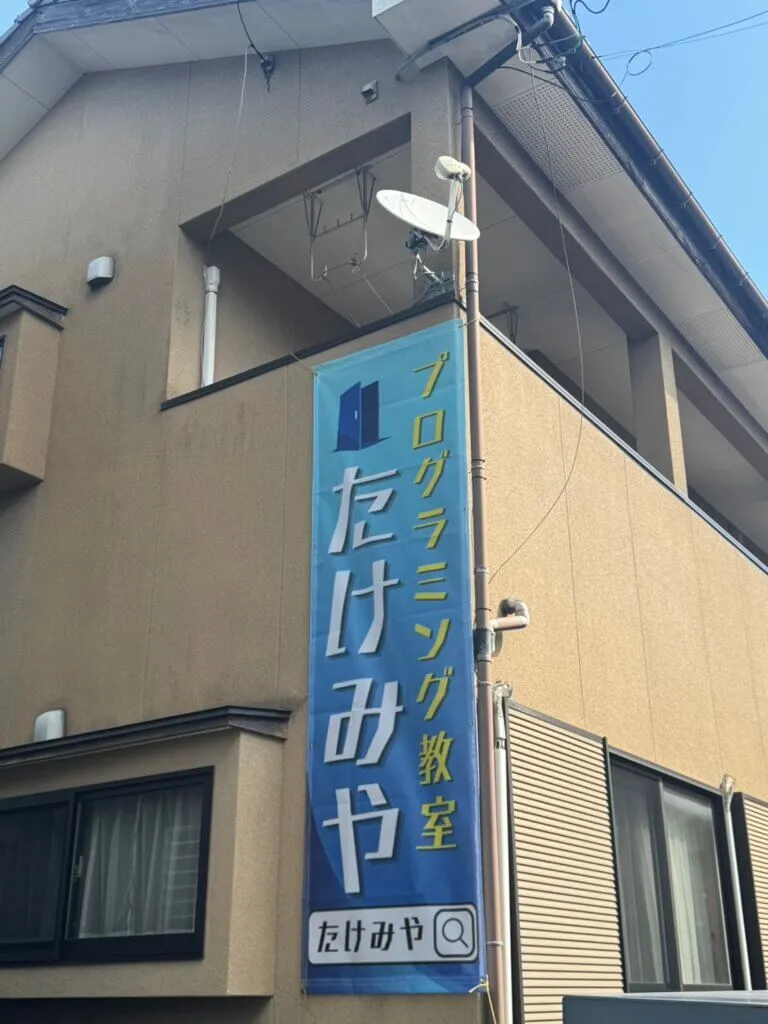 Just a 3-minute drive from Kengun Shopping Street, Takemiya Programming School welcomes everyone — from total beginners to experienced young coders.
It also operates as a free school (alternative learning space) for middle and high school students.
More than just a place to study, it’s a safe space where kids can grow at their own pace.
Starting in April, programming classes will also be offered at the Gakudo Kengun campus.
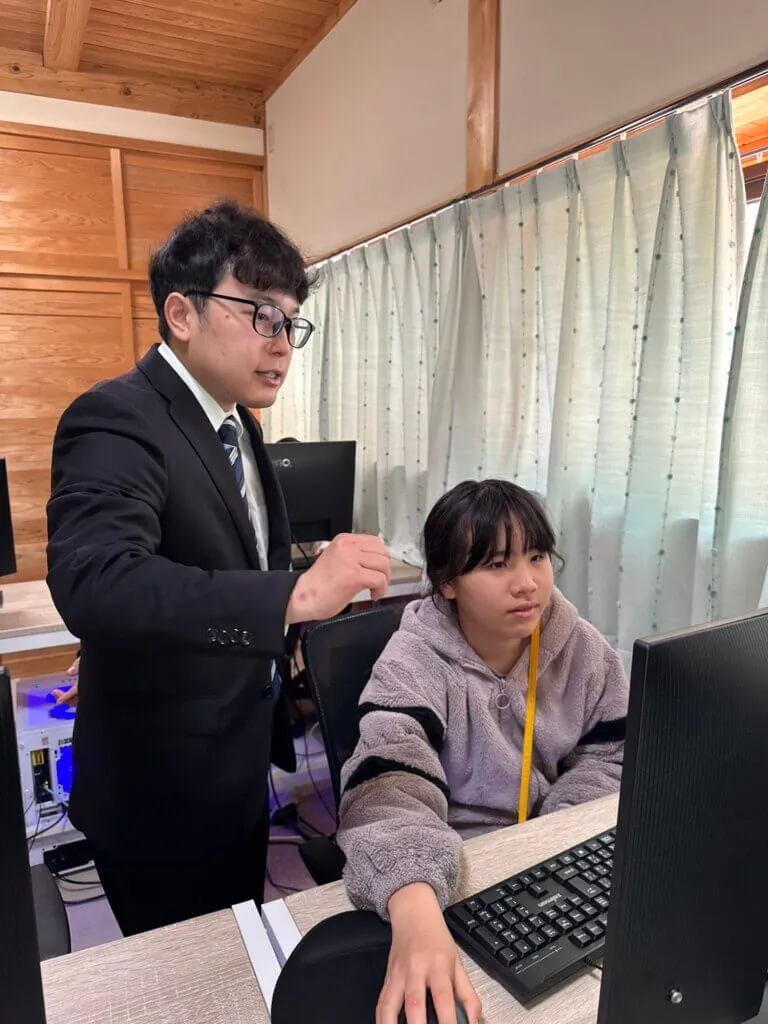 At Takemiya Programming School,
students stack up small “I did it!” successes through programming, gradually building both critical thinking and problem-solving skills.
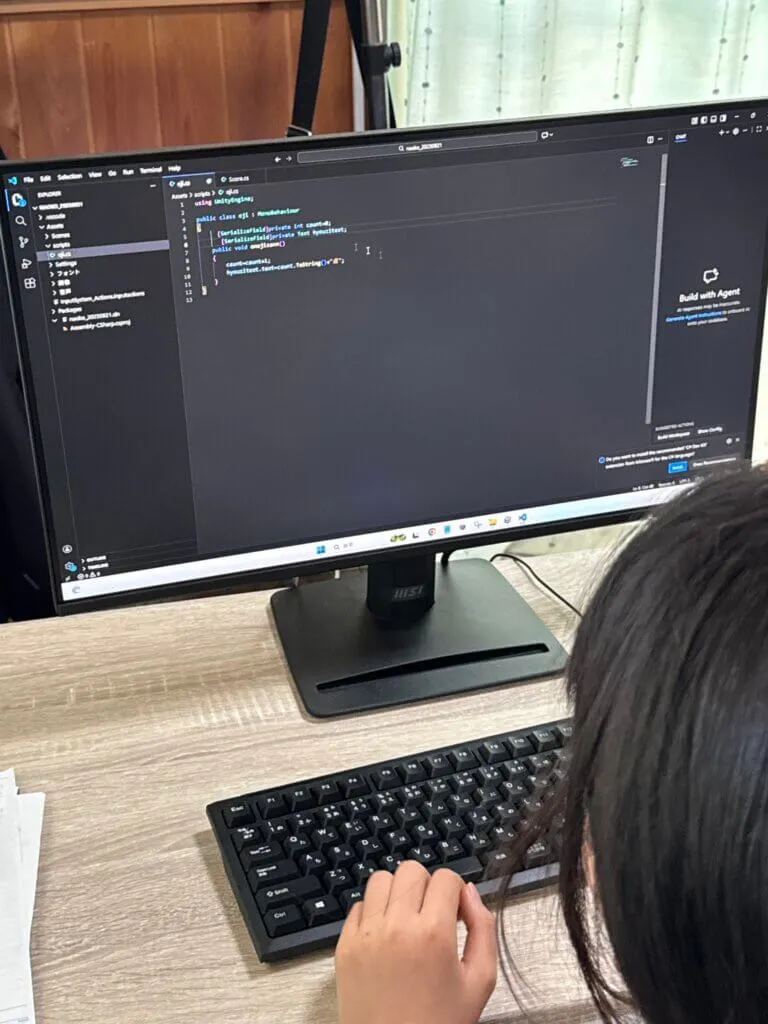 Programming is all about asking “Why? How? What can I try next?” — over and over again.
When a student gets stuck, instructors don’t simply hand over the answer. Instead, they ask guiding questions that help kids find the solution on their own.
Through this process of independent thinking and small wins, children develop the ability to learn proactively.
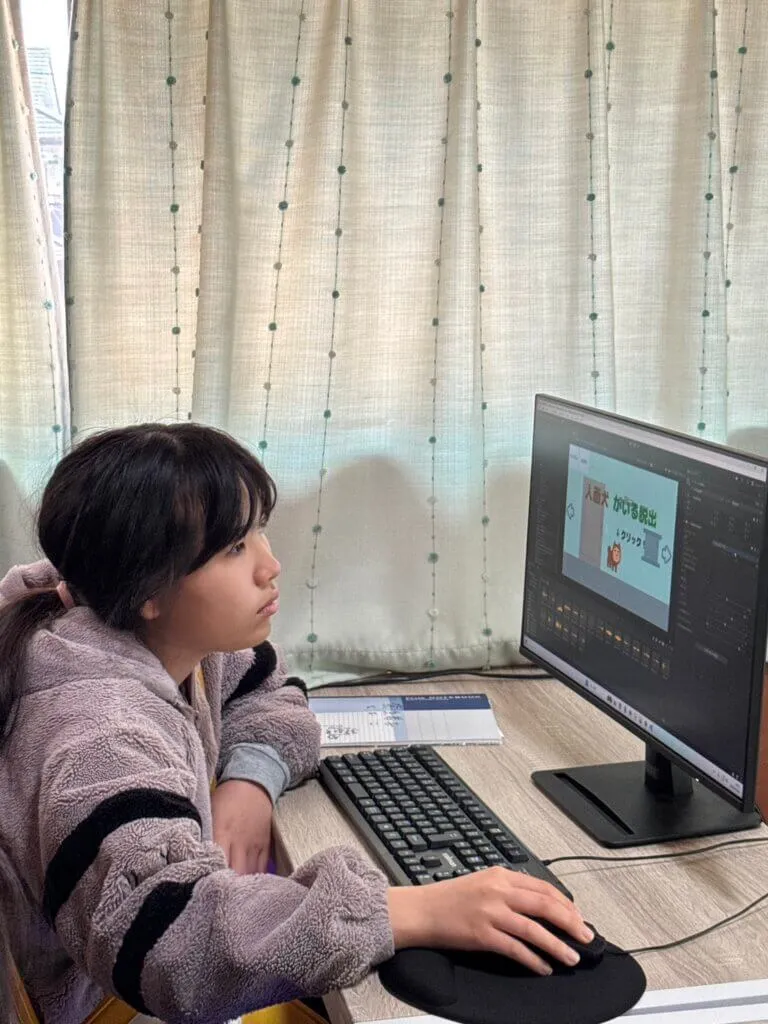 〈What Makes Takemiya Special〉
・Small-group, one-on-one lessons with custom-built materials matched to each child’s interests
・A wide range of courses — from absolute beginner (mouse skills, typing practice) to advanced
・Hands-on training with Unity, the same engine used in real game development
・Builds the ability to think “How can I make this work?” through programming
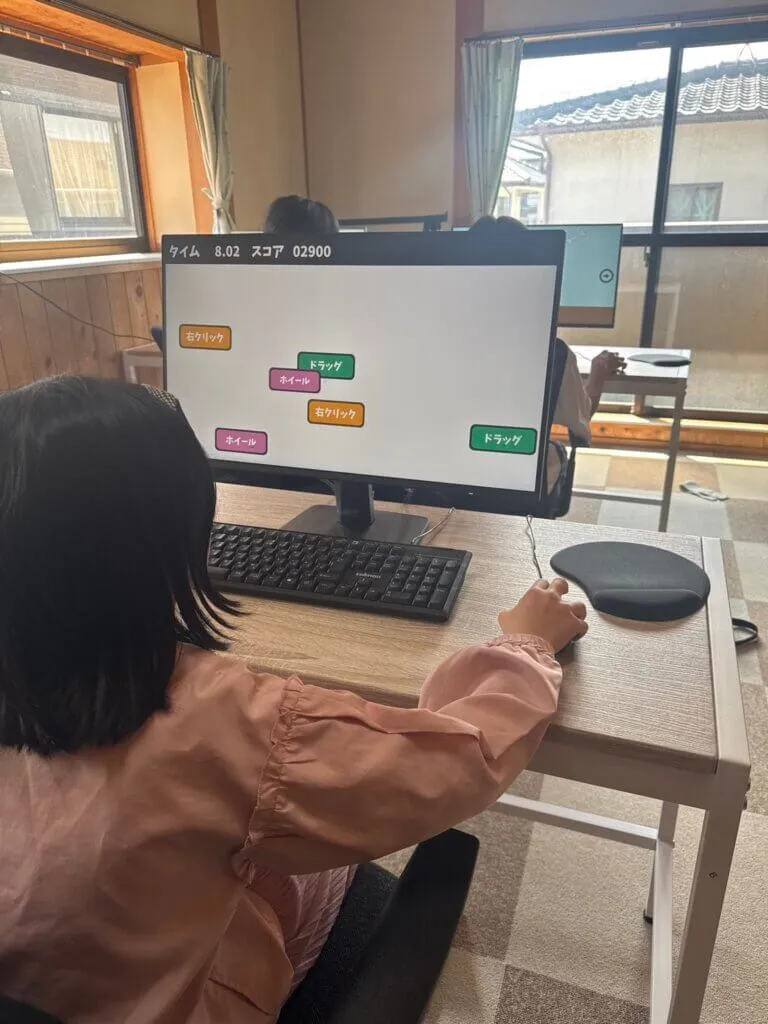 Lessons are flexibly tailored to each child’s pace.
No more worries about “Will my child fall behind the other kids?” — every learner moves forward on their own track.
Inside a Takemiya Lesson
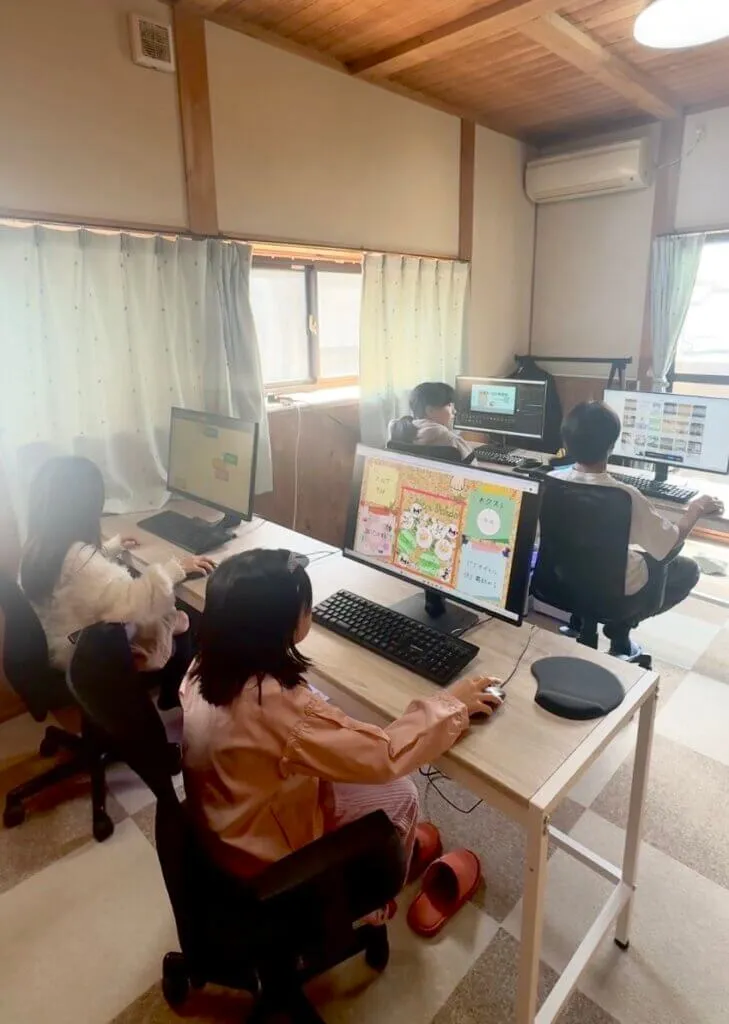
This time, we got to peek inside an advanced (Let’s Create) lesson.
You won’t find whiteboards or textbooks here.
Instead of a traditional one-way lecture, students learn at their own pace, working through problems thoughtfully.
That’s exactly why instructors can offer hands-on, attentive support tuned to each child’s understanding and working speed.
At Takemiya, kids learn programming through game development. Beginners start with the basics — mouse handling and typing practice.
Even foundational skills are taught through fun, game-style activities, so the learning never feels like a chore.
Before diving into building their own games, students explore sample games to understand sequential thinking and how Unity works.
From there, they start dreaming up the kind of game they’d like to create.
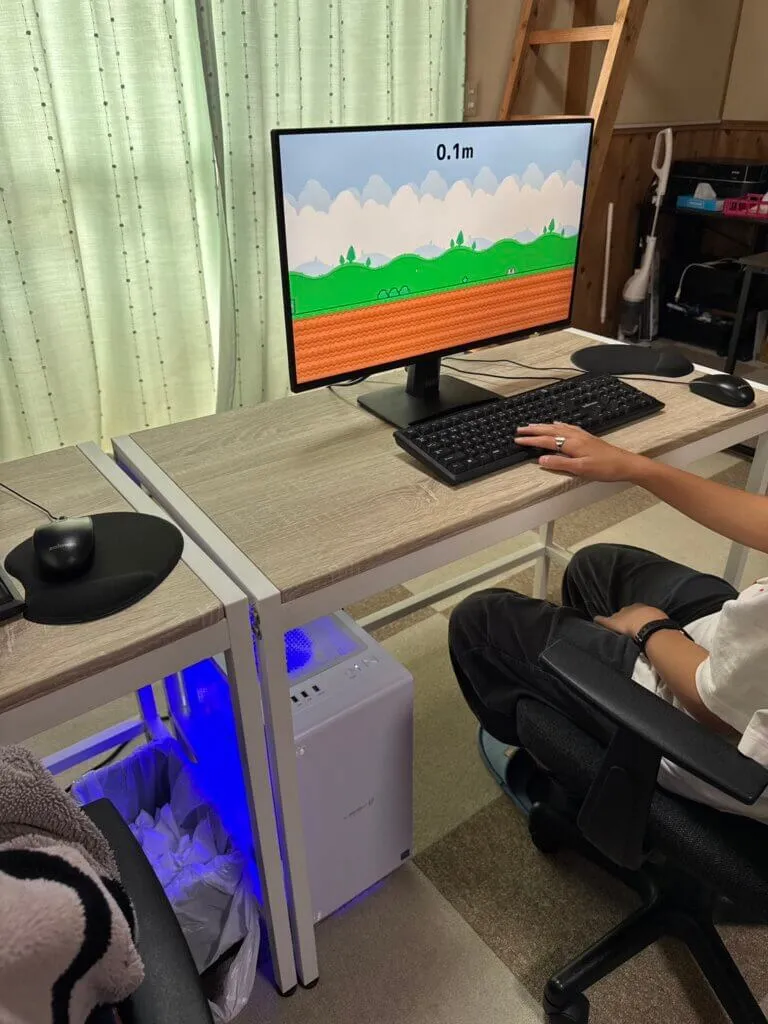
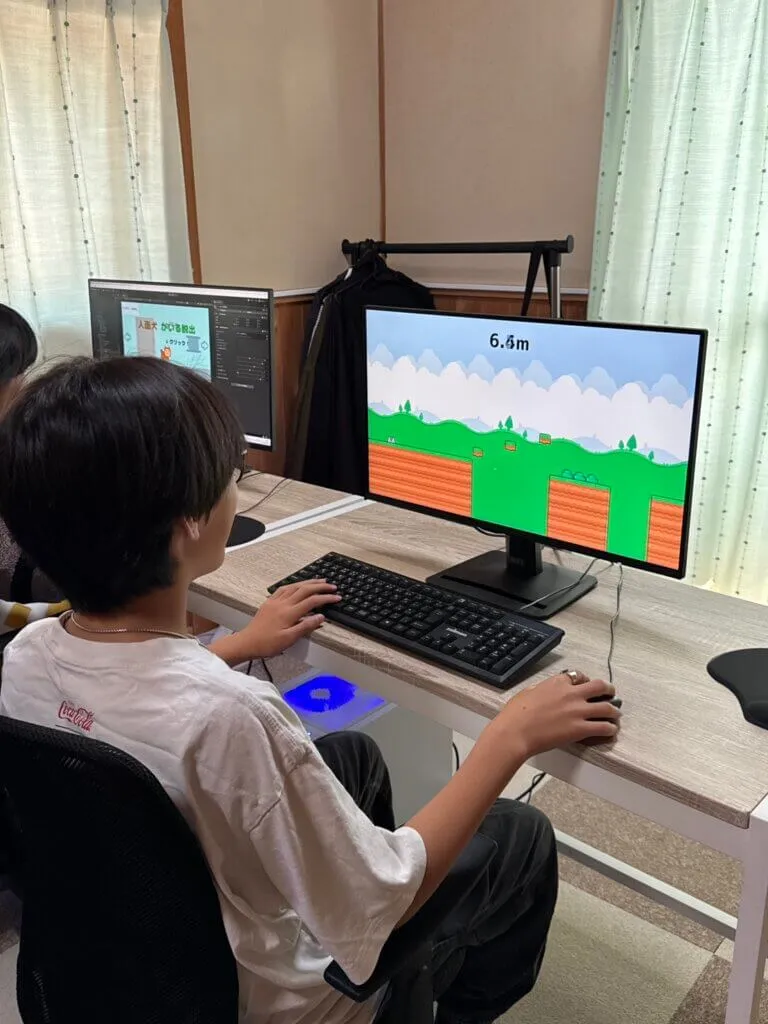
The student we observed was hard at work on an escape room game.
There are no instructions like “Today, do this task” — kids drive their own progress.
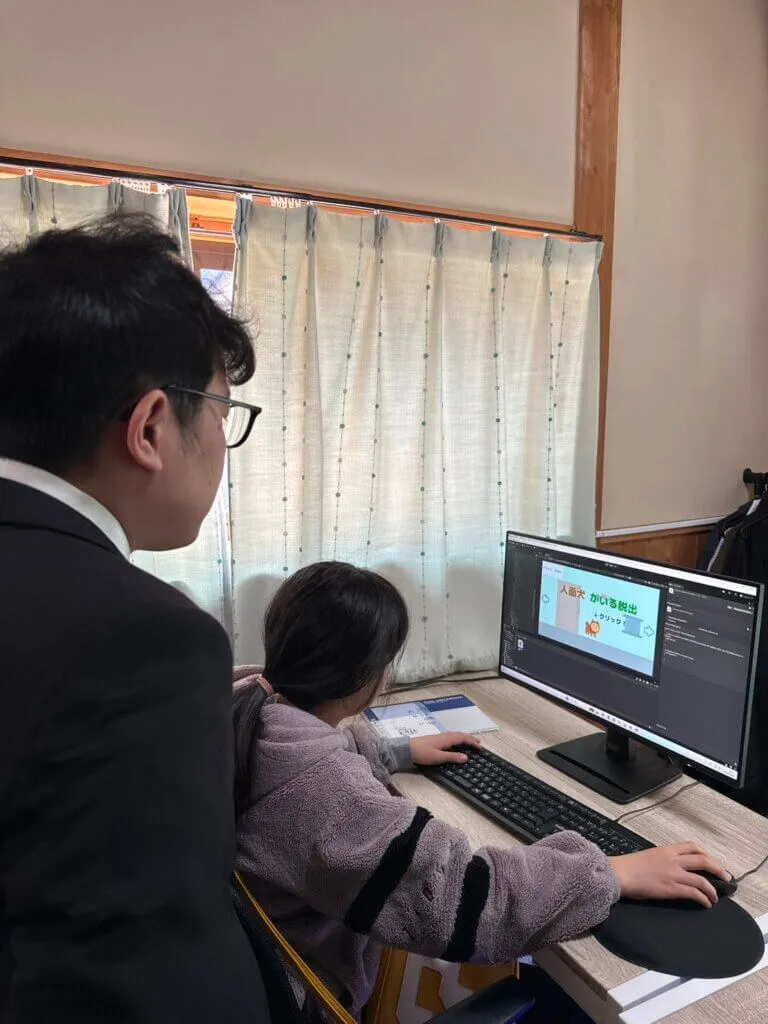 Because students lead the way, the teacher doesn’t stand at the front of the room — they support quietly from behind, ready to step in when needed.
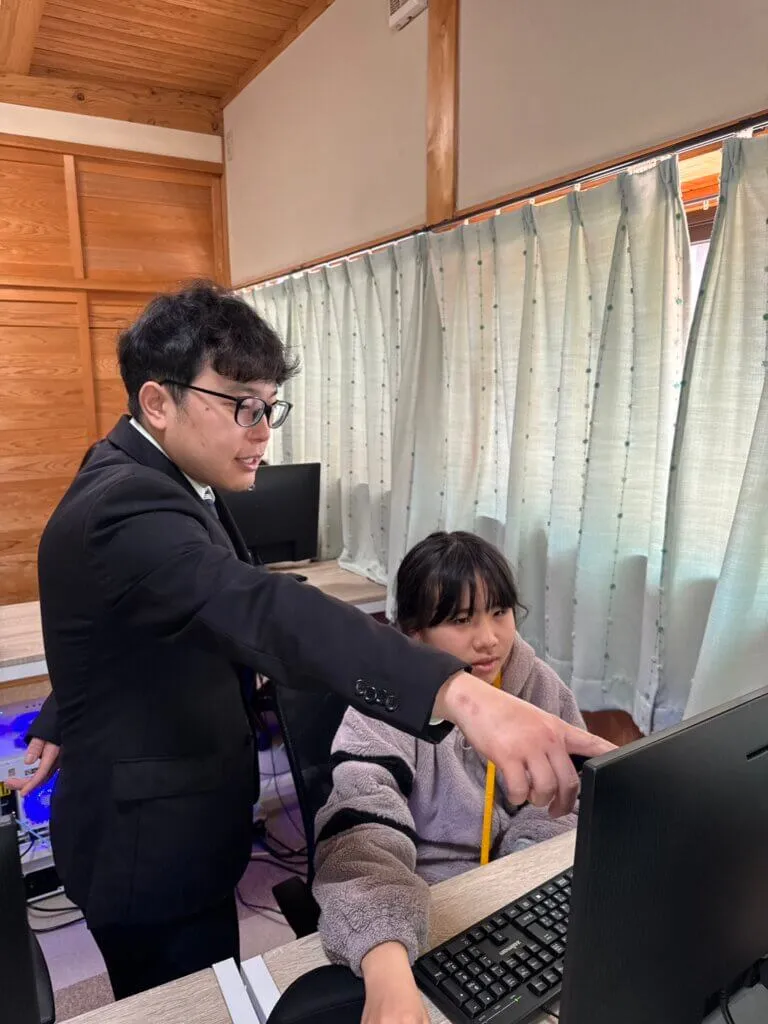 When a student hits a wall, the instructor encourages them to think it through first — never just handing over the answer.
“What do you want to make happen?”
“When the user clicks this, what should happen next?”
The teacher’s questions are designed to lead each child to discover the solution on their own.
Think it through. Try it. If it doesn’t work, find out why and try again.
This cycle builds not only programming chops but also that priceless ability to “think for yourself.”
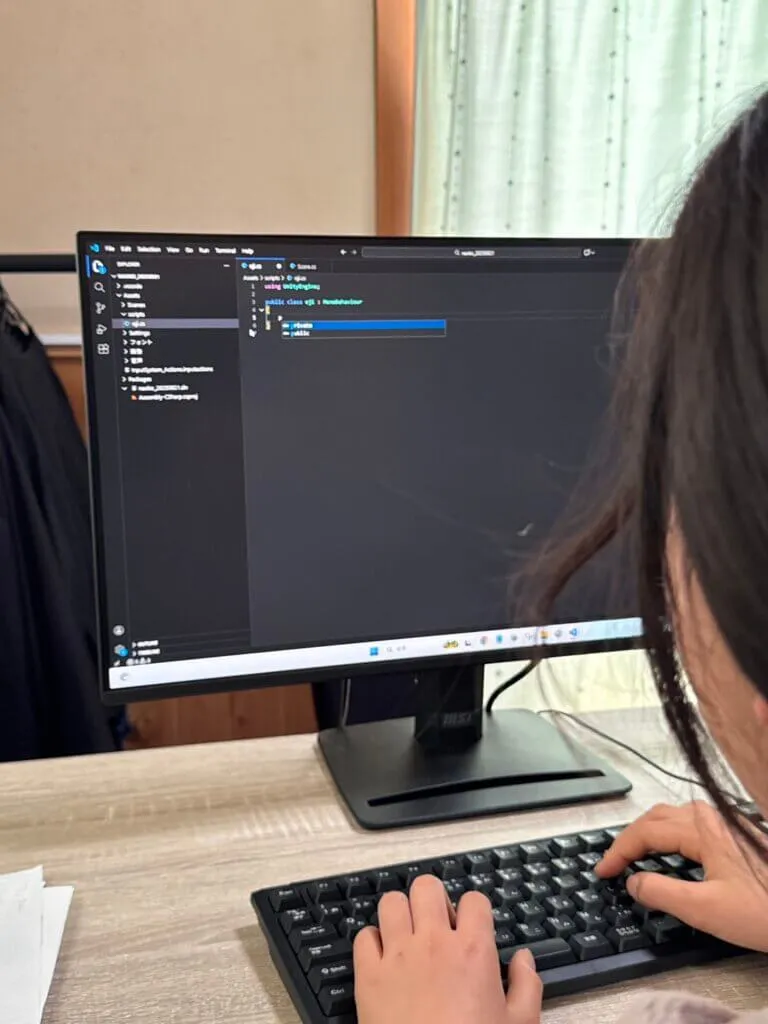 Since each student’s game is different, the code they need is different too — so all materials are individually customized.
No cookie-cutter projects here. Every child gets to build whatever they truly want to create.
The school uses Unity, the same professional game engine behind hits like Pokémon GO.
That means the skills learned here are genuinely real-world and industry-relevant.
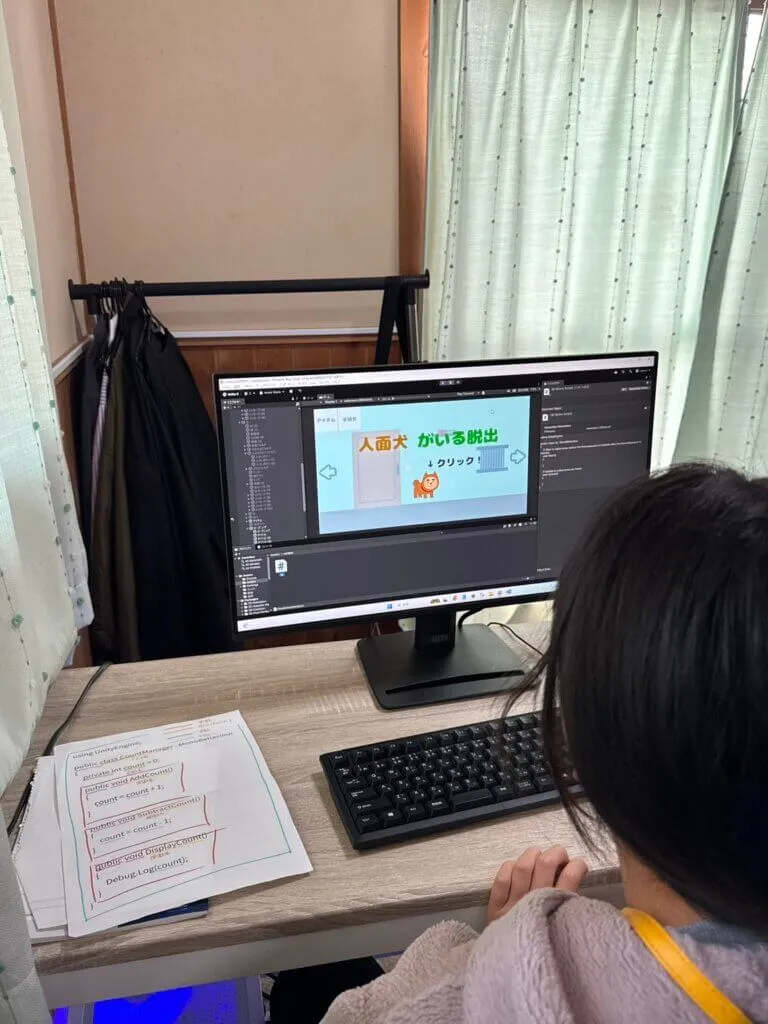 After typing in code, students test whether the program behaves the way they intended.
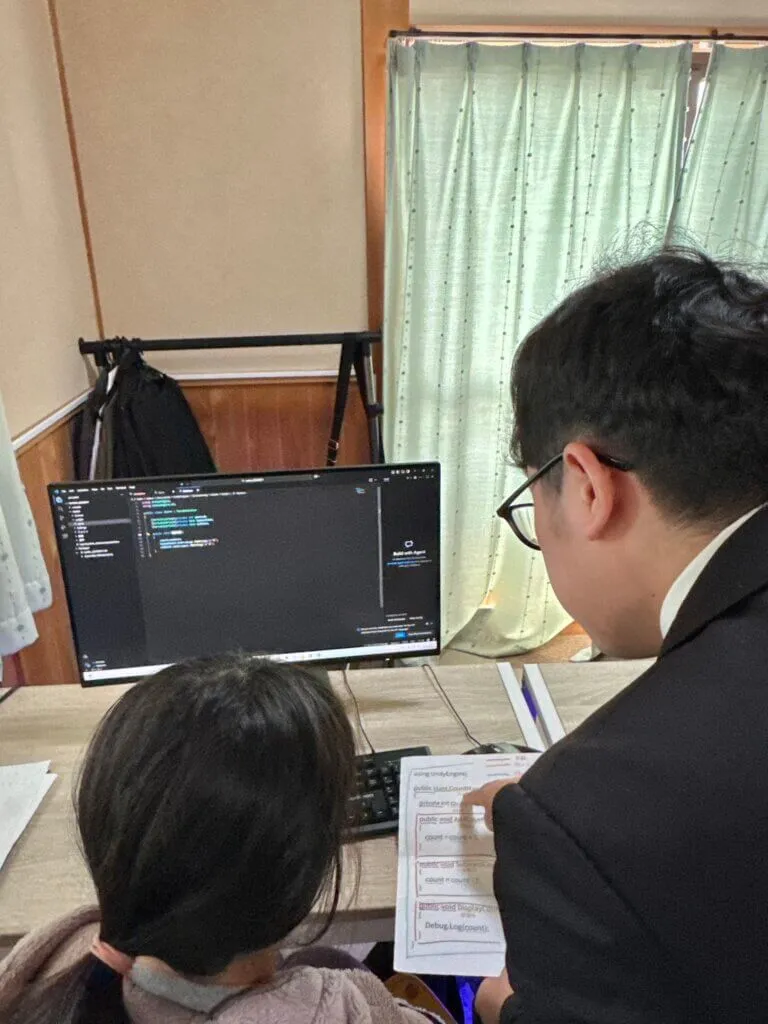 When something doesn’t work, they trace the cause, try again, and slowly bring their game to life.
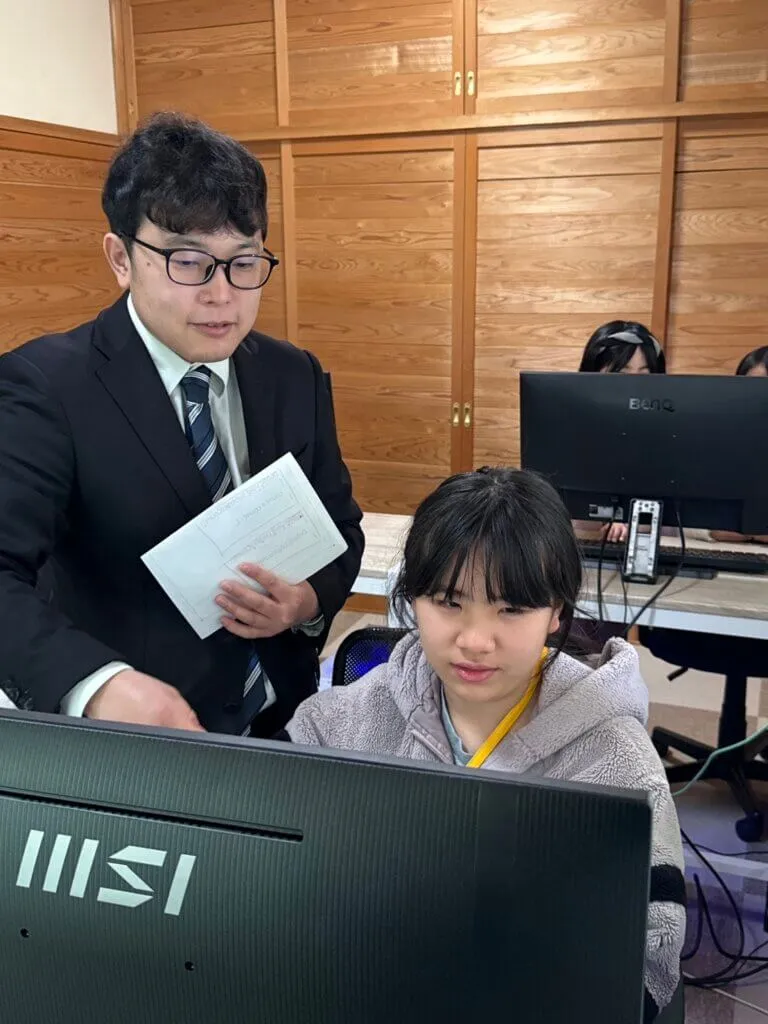 Even kids who started by just learning to use a computer eventually level up — bit by bit — until they’re shaping their very own original games.
Finished games can even be uploaded to free-game websites for the public to enjoy.
There’s something incredibly empowering about hearing strangers say they loved playing your creation!
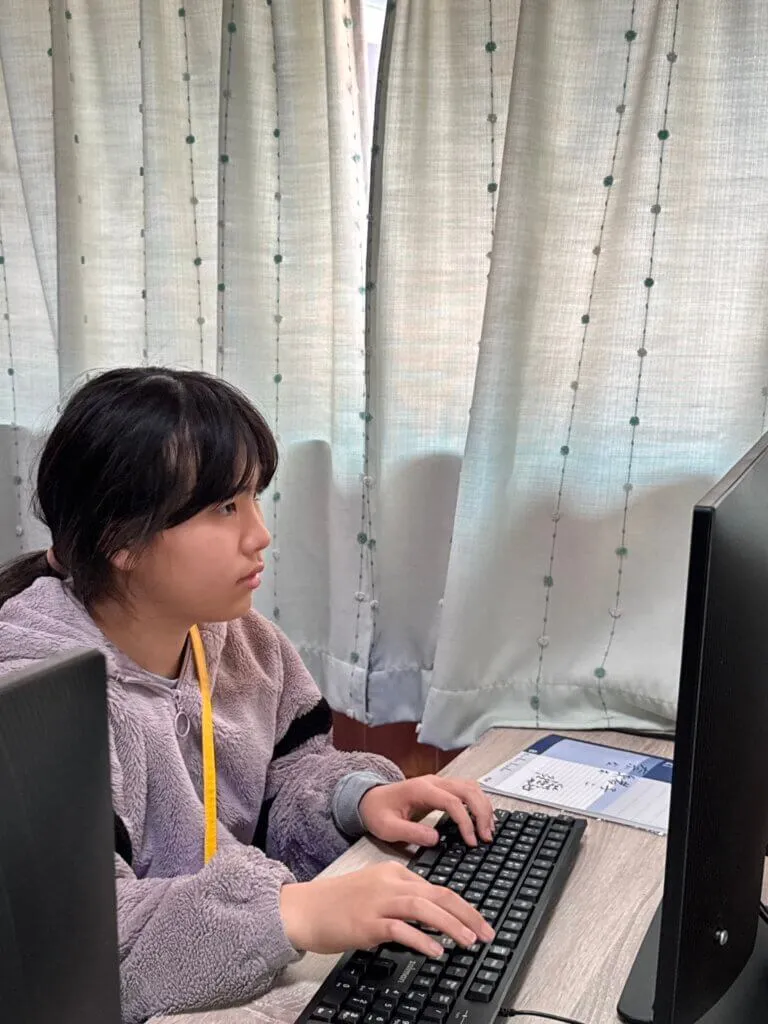 Remarkably, one Takemiya student placed in the Top 300 of an 11,000-entry contest within their first month of joining.
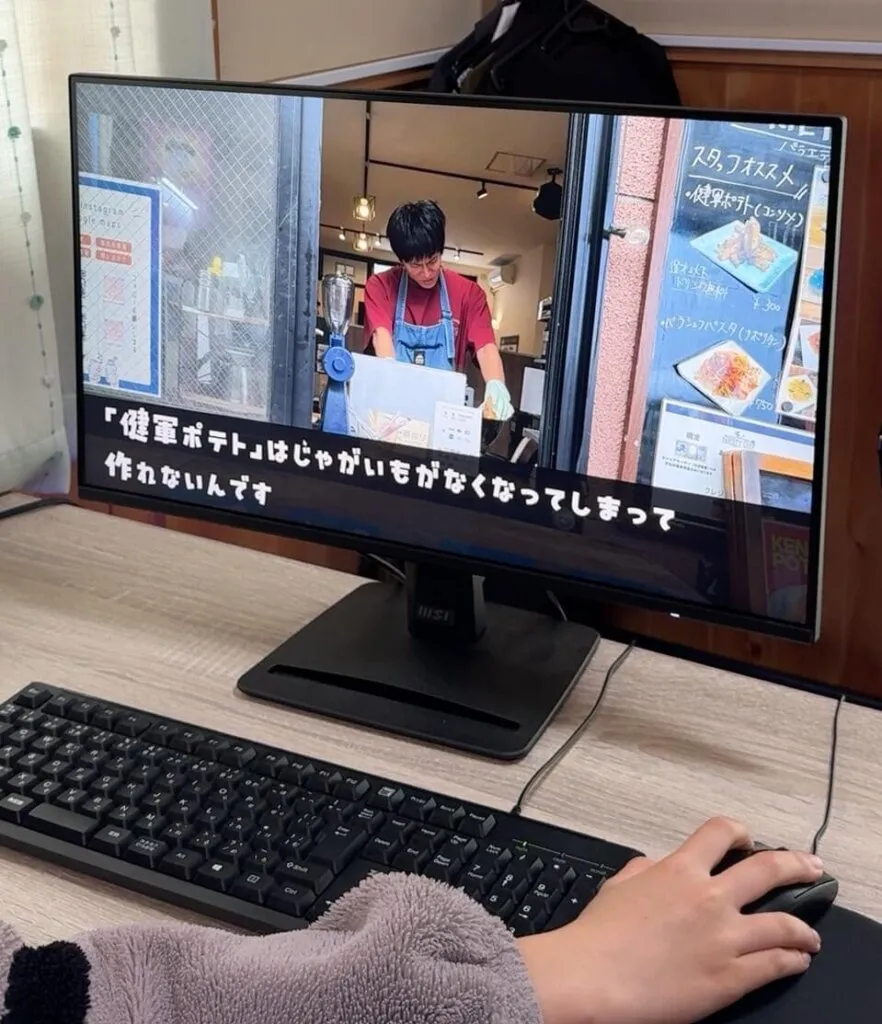 For projects themed around Kengun Shopping Street or Lake Ezu, students even venture out for interviews and photo shoots on location.
That’s the magic of a small-group format — instructors can support each project right down to the finest details.
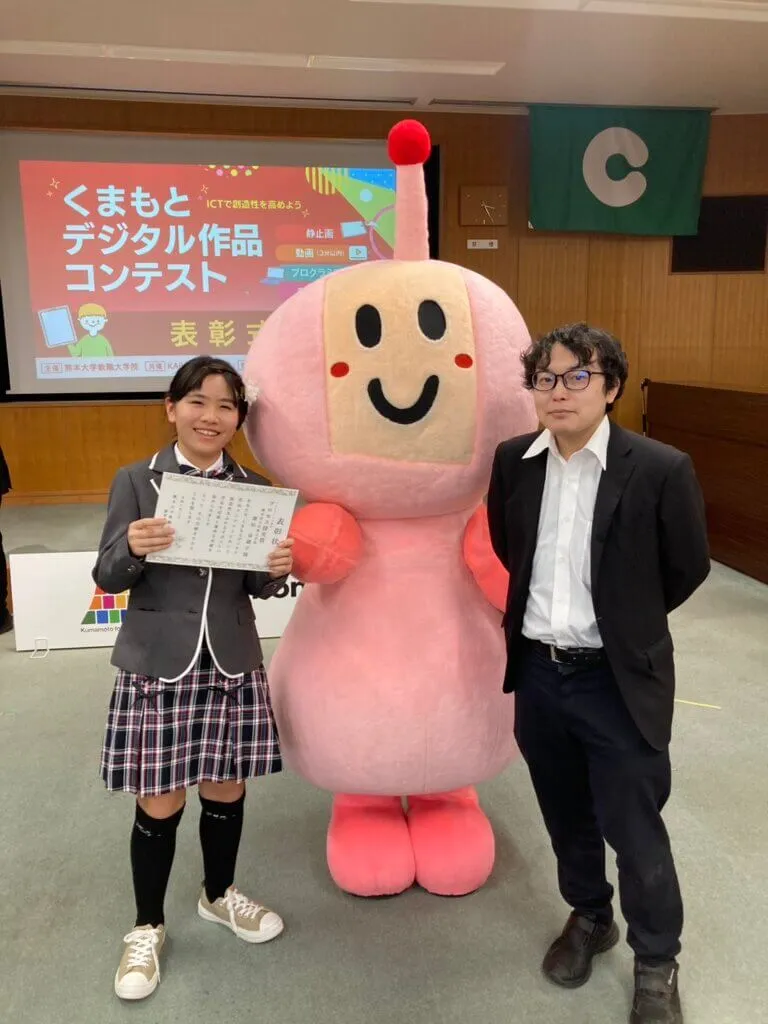 Winning recognition in a contest gives kids a huge confidence boost — and motivates them to take on even bigger challenges next.
Discovering your own goal and pursuing it independently is something that traditional school doesn’t always offer.
That’s why having a safe environment with personalized support is such a gift — for kids and parents alike.
Lessons run for 180 minutes, and kids are free to take breaks or push forward whenever it suits them.
Working at one’s own pace makes it easier to stay focused without burning out.
Personalized support combined with a self-directed environment helps kids develop the kind of independent thinking they’ll carry far beyond the classroom.
Meet the Instructor
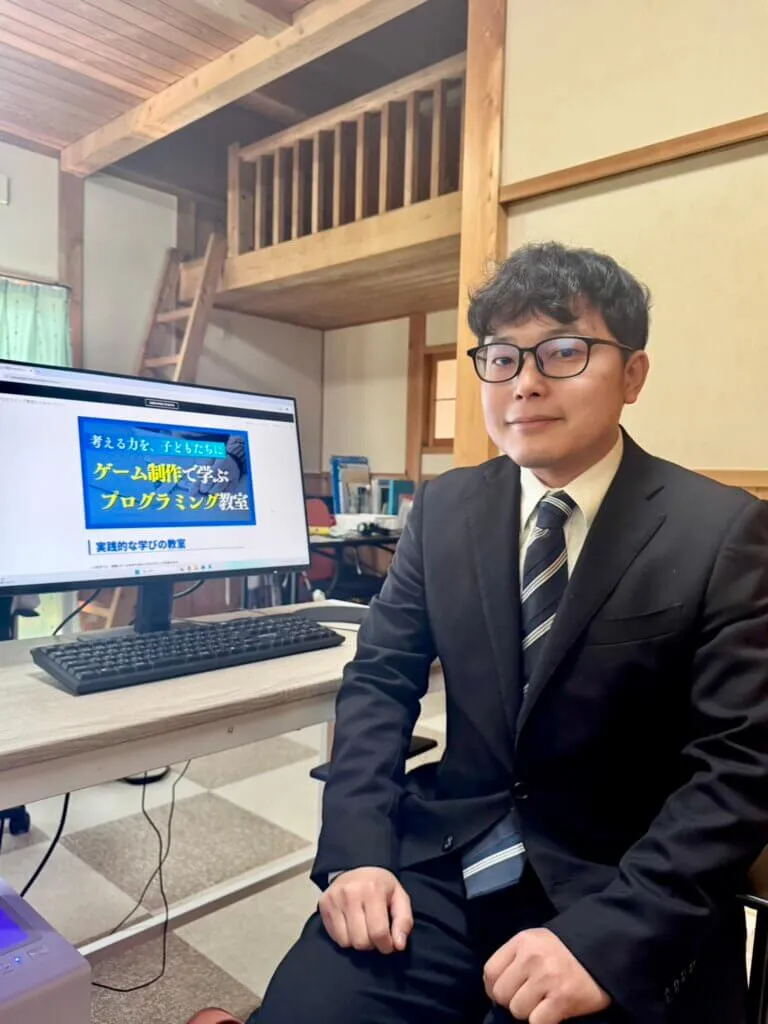 Director and Lead Instructor of Takemiya Programming School
Mr. Takemi Honda
“I founded this school to help children realize that ‘their potential is limitless.’“
While programming education is having its moment in the spotlight, this isn’t simply a place to learn code.
Through fun, hands-on game development, students cultivate:
・The habit of thinking and experimenting on their own
・The mindset of asking “How can I solve this?”
These are the deeper, life-long aspects of true learning.
By tailoring support to each child and stacking up small “I did it!” wins, students develop the confidence to tackle whatever comes next.
Exposure to design, modeling, and other creative areas can also help kids uncover talents and passions they didn’t even know they had.
This kind of learning can broaden their future options — and their sense of what’s possible.
“There are no chances to try the things I want to do.” “I’m afraid to fail.” “I can’t learn at my own speed.”
Takemiya has built an environment specifically designed to address these worries.
There’s no need to fear falling behind classmates here.
Parents can rest assured leaving their kids in caring hands.
The school is here to support every child’s challenge — by helping them think it through and find their own answers.
During the free trial session, you’ll get to witness firsthand the joy and confidence on your child’s face when they say “I did it!”
Classes & Pricing
[Let’s Think (Beginner Course)] 4 sessions/month
・Schedule: Wednesdays or Thursdays, 18:30–19:30
・Location: After School Gakudo Kengun
・Monthly fee: 6,600 yen
・Eligibility: Elementary school grades 2–6
[Let’s Create (Advanced Course)] 4 sessions/month
・Schedule: Weekends & holidays 9:00–12:00 / 13:00–16:00 / 17:00–20:00
・Location: Takemiya Programming School
・Monthly fee: 9,800 yen
・Eligibility: Elementary 4th grade through high school. Frequency and time slots can be adjusted to suit your child’s pace and preferences.
・Eligibility: Middle school through high school〈Light〉
・3 days/week, 8:00–13:00
・Monthly: 29,800 yen 〈Regular〉
・4 days/week, 8:00–13:00
・Monthly: 36,800 yen 〈Full-Time〉
・5 days/week, 8:00–13:00
・Monthly: 42,800 yen No additional fees.
Days and attendance patterns can be discussed and customized.
Trial Sessions & Enrollment
 Takemiya Programming School offers free trial sessions, so kids and parents can give it a try with no pressure.
[How to Apply for a Trial]
Free Trial Application Form — sign up here.
・Duration: 180 minutes
・What to bring: Nothing
・Format: Children alone or with parents are both welcome
・Location: Takemiya Programming School (5-18-46-1 Wakaba, Higashi Ward, Kumamoto City)
・Available times:
Weekdays: 9:00–12:00
Weekends & Holidays: 9:00–12:00, 13:00–16:00, 17:00–20:00
Please pick the time slot that works best for you.
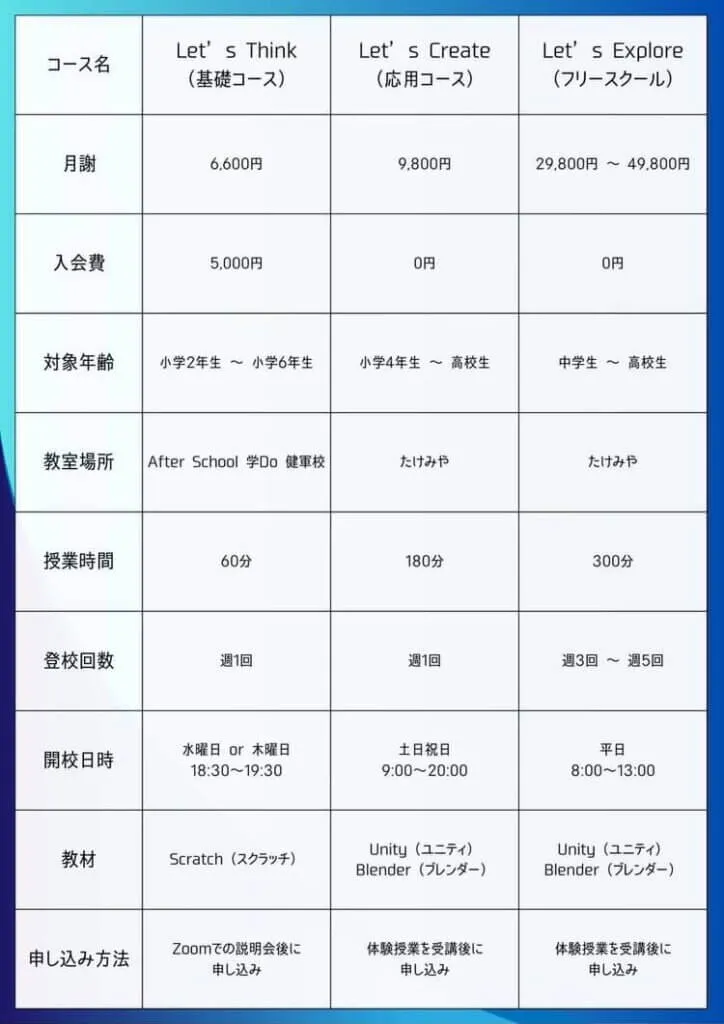 ※Image content is subject to change. Please check Takemiya’s official LINE account for the latest information.
[About Enrollment]
For details on enrollment, free trials, and information sessions, please check the Takemiya Programming School Official LINE.
[Enrollment Fee]
An enrollment fee of 5,000 yen applies to the Let’s Think (Beginner) course only.
All other courses have no enrollment or extra fees.
Takemiya Programming School builds confidence and critical thinking through game development.
What kids gain here goes well beyond technical skills — creativity, imagination, and problem-solving abilities are part of the package.
It’s a warm, welcoming school where every child’s “I want to try!” is supported with care, at a pace that fits them perfectly.
More than school and more than home, it offers a comfortable third space where kids genuinely feel safe.
If you’re hoping your child can grow more confident
and chase what they love with their head held high,
Takemiya is the perfect fit.
Start with a free trial — and witness your child’s first “I did it!” moment for yourself.
Follow us on Instagram for daily updates!
SaruKuma shares lunch spots, parks, indoor activities, and more — tailored for families raising kids in Kumamoto.
We’d love to have you with us(*´∀`*)

Takemiya Programming School — Location Information
-
Address
Wakaba, Higashi Ward, Kumamoto City
-
No
Tatami Seating
-
No
Private Rooms
-
No
Children’s Tableware
-
No
Children’s Chairs
-
No
Diaper Changing Station
-
No
Stroller Access
Frequently Asked Questions
What’s a great family-friendly spot in Wakaba, Higashi Ward, Kumamoto City?
“Takemiya Programming School” is welcoming for families with kids and a popular spot in Wakaba, Higashi Ward. Read on for full details.
What are the operating hours and closing days for Takemiya Programming School?
Operating hours and closing days may change. Please check the official website or call ahead before your visit.
※Information current as of the time of reporting. Prices and operating hours are subject to change. Please check before visiting.
🗺️ Planning a trip to Kumamoto?
🎟️ Find Things to Do🏨 Find Hotels
We may earn a commission from bookings made through these links, at no extra cost to you.
Article Writer
Sarukuma Editorial
Sarukuma Editorial is a small team of locals based in Kumamoto, Japan, sharing the hidden gems, hometown flavors, and seasonal experiences that make our region special. We write the kind of guide we wish we had when showing friends around — honest, practical, and made by people who actually live here.
Popular Ranking
-
Inside Cafe106, Minami-ku’s Cozy New Hideaway with Kumamoto’s Best Peach Frappe
Food & Restaurants
2026.4.27
1 -
Minamiaso Fureai Zoo Fairy Tale (Takamori, Aso) — A Hidden Gem Where You Can Cuddle Goats, Rabbits, Chicks & More!
Outing Spots
2025.12.13
2 -
Costco Kumamoto Mifune Warehouse: Grand Opening April 1st – A First Look at Kumamoto’s Newest Wholesale Destination (Mifune Town)

Outing Spots
2021.3.11
3 -
Shiroyama Park in Nishi Ward, Kumamoto City — Free Parking, Baby Swings & a Toddler Zone Perfect for Little Ones!
Outing Spots
2026.1.19
4 -
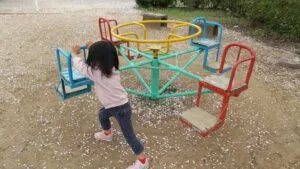
Tsukiji Shijukudai Park: A Family-Friendly Park with a Unique Rotating Chair Playground in Tamana City
Outing Spots
2021.4.30
5 -
Children’s Day in Kumamoto: 7 Family-Friendly Spots for Indoor Play & Hands-On Fun [2026 Edition]
Activities & Tips
2026.4.23
6 -
Imakin Shokudo: Famous Akaushi Beef Bowl at a Beloved Historic Restaurant in Aso, Kumamoto

Food & Restaurants
2020.9.18
7 -
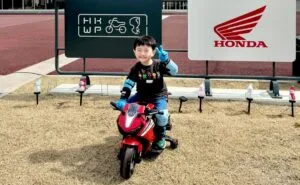
Honda Kumamoto Welcome Park (Ozu Town): A Free Motorcycle Theme Park with Electric Bike Rides and Hands-On Exhibits!
Outing Spots
2026.3.7
8 -
Sarukuma Editors’ Picks! Top 7 Family-Friendly Spots in Kumamoto for 2025 — Where to Take Your Kids Tomorrow!
Activities & Tips
2025.12.27
9 -
Amu Plaza Kumamoto: A Family-Friendly Shopping Destination at Kumamoto Station (Nishi-ku, Kasuga)
Outing Spots
2021.5.14
10
Keywords
You Might Also Like
RECOMMEND
-

Uoya Daichan: A Hidden Gem Fish Market in Kumamoto’s Minami Ward
Food & Restaurants
2020.10.28
-
Rendaiji Park: A Family-Friendly Park with Playground, Sports Ground & Possible Shinkansen Sightings (Nishi Ward, Kumamoto City)
Outing Spots
2020.12.24
-
Sakata Sweet: Heavenly Chiffon Cakes & Sweet Potato Treats in Nishihara Village, Kumamoto
Food & Restaurants
2020.10.19
-

“Montmartre” — Delicious, Affordable Takeout Bento from Sojo University’s Cafeteria | Tokuou, Kita-ku, Kumamoto City
Food & Restaurants
2021.3.19
Editor's Picks
PICK UP
Check latest info
on Instagram!

Check latest info
on Instagram!
Follow Sarukuma on Instagram for the latest food spots and event info!
- Search